The 3-Part Content Strategy That Grew Our Business to $20 Million
This video reveals a simple yet effective 3-part content strategy that helped a business grow from $500 to nearly $20 million annually. The strategy involves carefully planning content across a monthly calendar, focusing on specific content types, and continuously improving them to foster strong audience connections.

- 1. Sales Offers: Focus on clear, simple offers (e.g., percentage off, free shipping, BOGO, bundles, dollar amount off). Provide a logical reason for the sale and maintain a respectful cadence, such as two offers per month, to avoid audience fatigue.

Visual list of simple offers: % OFF, FREE SHIPPING, BOGO, BUNDLE, $$ OFF [ 00:03:25 ] - 2. Educational Content: Deliver value through educational content, often presented as listicles (e.g., "3 steps to X"). This builds connection, authority, and trust, pre-framing your audience to see your products as solutions.
- 3. Storytelling: Integrate stories into both sales and educational content. A basic story structure involves Intent, Obstacle, and Resolution. Stories based on brand mission, values, and how products solve problems create powerful connections, achieving maximum impact where these elements intersect.
By consistently applying these three content types, focusing on relevance and building strong relationships, businesses can achieve significant growth and establish lasting trust with their audience.

A hand-drawn Venn diagram illustrating the intersection of "Mission," "Values," and "Problem/Solution" for maximum impact [ 00:11:14 ]
The speaker shares a three-part content strategy that scaled their business from $500 to nearly $20 million per year. This strategy emphasizes focusing on specific content types, continually improving them, and fostering a strong connection with the audience.
The Three Pillars of Marketing Content [0:47]
The core of the marketing strategy relies on consistently producing three types of content, getting better at each over time, and using them to draw the audience closer to the brand.
- Overall Strategy
- The marketing approach involves filling a calendar month with various content types, including emails, social ads, and more [2:04].
A hand-drawn calendar representing a month for content scheduling [ 00:02:03 ] - The goal is to connect with people and convert them into customers by strategically deploying these content types.
- The marketing approach involves filling a calendar month with various content types, including emails, social ads, and more [2:04].
1. How to Sell (Offers) [1:40]
Sales content is crucial for profitability, serving as the ultimate goal toward which other content leads.
- Keep Sales Offers Simple [3:17]
- Use straightforward incentives:
- Percentage off
- Free shipping
- Buy one, get one (BOGO)
- Bundle and save
- Dollar amount off
- Simplicity ensures clarity and effectiveness.
Visual list of simple offers: % OFF, FREE SHIPPING, BOGO, BUNDLE, $$ OFF [ 00:03:25 ]
- Use straightforward incentives:
- Create a Reason Why [3:29]
- Justify the sale logically to appeal to the rational part of the customer's brain.
- Examples of reasons: calendar dates, overstocked inventory, or even a whimsical reason like "woke up feeling frisky."
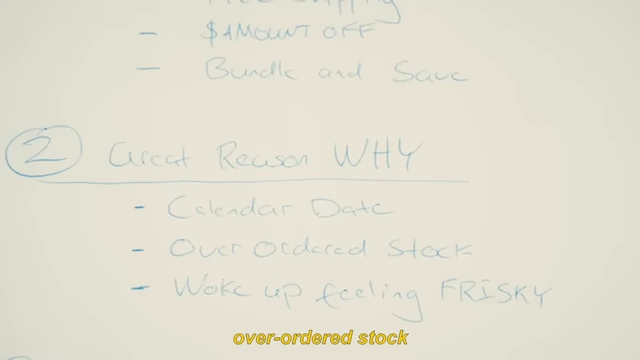
Examples of reasons to justify a sale: calendar date, over-ordered stock, or a whimsical reason [ 00:04:01 ] - This justification aligns emotional appeal with logical reasoning, leading to higher conversion rates.
- Maintain a Respectful Cadence [4:07]
- Avoid overwhelming the audience with too many sales messages.
- The speaker recommends around two offers per month, allowing space for other content.
- This balance optimizes short-term profits while nurturing long-term customer relationships.
2. Education [5:23]
Educational content builds value, establishes authority, and fosters trust, preparing the audience for transactions.
- Value and Authority Building [5:28]
- Education provides value, making content useful to the audience.
- Useful content increases connection and grants the brand authority.
- Authority leads to trust, which is essential for successful transactions.
- Using Listicle Format [5:50]
- Educational content can effectively be structured as listicles.
- This format, like "Seven ways to X" or "Three steps to Y," helps organize information clearly for the audience.
- It guides content creation in a logical sequence, ensuring consistency and understanding.
- Solving Problems [6:41]
- Brands should identify the problems they solve for customers.
- Educational content should pre-frame the audience with necessary knowledge, positioning the brand's product as the best solution.
- Giving away "free game" (valuable information) builds knowledge and allows the audience to perceive value and trust in the brand.
3. Connect with Story [8:13]
Storytelling is a powerful "cheat code" that amplifies the effectiveness of both sales and educational content.
- The Power of Narrative [8:44]
- Stories enhance the impact of offers and educational listicles.
- They are critical for business growth and building deeper connections.
- Basic Story Structure [9:22]
- A simple story consists of three elements:
- Intent: What the brand set out to do (e.g., "We set out to give you XYZ"). This relates to the brand's overall mission.
- Obstacle: The "annoying thing" that got in the way (the conflict).
- Resolution: How the obstacle was overcome, often involving sacrifice to achieve the initial intent.
- A simple story consists of three elements:
- Building Blocks of Story [10:57]
- Key elements to draw from for narrative creation:
- Brand values
- Mission
- Product values
- "Enemies" (what the brand stands against or challenges)

Handwritten notes detailing elements for storytelling, including Brand Values, Mission, Product Values, and Enemies [ 00:10:59 ]
- Key elements to draw from for narrative creation:
- The Venn Diagram of Impact [11:09]
- The intersection of mission, values, and problem/solution creates maximum impact.
- When discussing the brand's mission and values (especially when tested), and aligning it with the problem-solving nature of the products, a powerful narrative emerges.
A hand-drawn Venn diagram illustrating the intersection of "Mission," "Values," and "Problem/Solution" for maximum impact [ 00:11:14 ] - Products are always solutions to problems, and stories should highlight this connection.
Wrapping It Up: The Glue of Content [12:37]
The success of these three content types is cemented by two factors:
- Relevance: Ensure content is useful, interesting, and important to your audience.
- Connection: Content should bring people closer to your brand and products. By mastering these elements and consistently applying the strategy of integrating sales offers, educational content, and storytelling, businesses can achieve sustained growth. The key is continuous repetition and improvement in execution.