September 2025 Economic Update: Recession Indicators, Job Market Contraction, Inflation, and Personal Finance Strategies
Summary:
This September 2025 economic update details concerning trends pointing towards a potential recession. Key highlights include:
- An unprecedented revision of -911,000 jobs thought to exist between March 2024 and March 2025, surpassing the Great Recession's revision.

BLS News Release: Current Employment Statistics Preliminary Benchmark [ 00:02:00 ] - Initial weekly unemployment claims reached a four-year high, with 25% of the unemployed seeking jobs for over six months, indicating a tough job market, especially for new graduates.
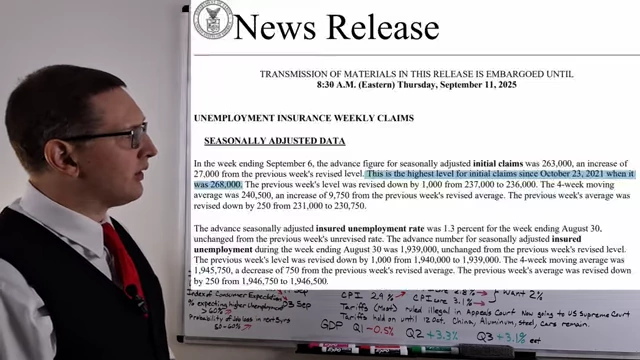
News Release: Unemployment Insurance Weekly Claims [ 00:01:10 ] - Consumer sentiment is at a record low since 2013, with over 60% expecting higher unemployment and 50-60% fearing job loss within five years.
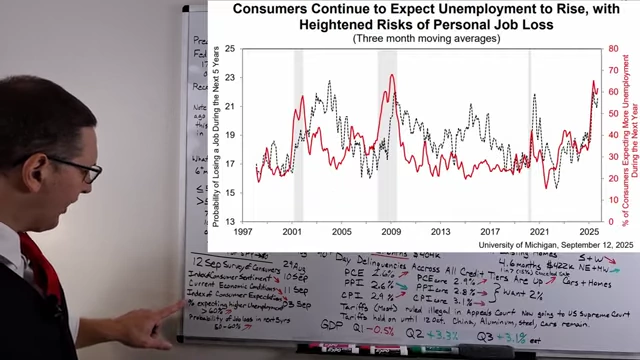
Chart: Consumer Expectations for Rising Unemployment and Job Loss [ 00:02:30 ] - Only 22,000 jobs were added in August, and June saw a net loss, while there are 7.4 million unemployed people for 7.2 million open jobs (many potentially "ghost jobs").
- 34% of CEOs plan to reduce their workforce, continuing an upward trend in anticipated layoffs across various sectors.

Leading Companies That Announced Layoffs in 2025 [ 00:07:09 ] - The housing market shows new homes at 9.2 months of inventory (a buyer's market), and 90-day delinquencies are rising across all credit tiers.
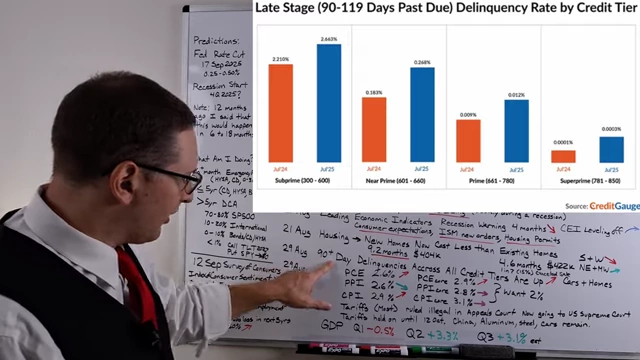
Late Stage Delinquency Rate by Credit Tier [ 00:09:29 ] - Inflation metrics (PCE, PPI, CPI) remain above the Fed's 2% target, forcing the Fed to abandon its flexible average target.
- The speaker predicts a Fed rate cut on September 17th and a recession starting in Q4 2025, advising building a 6-month emergency fund and using dollar-cost averaging for long-term investments.
The Economy vs. The Stock Market [0:00]
The presenter clarifies that the economy and the stock market are distinct.
- Stock Market's Forward-Looking Nature:
- Stocks tend to bottom out approximately six months before unemployment peaks, indicating their forward-looking nature.
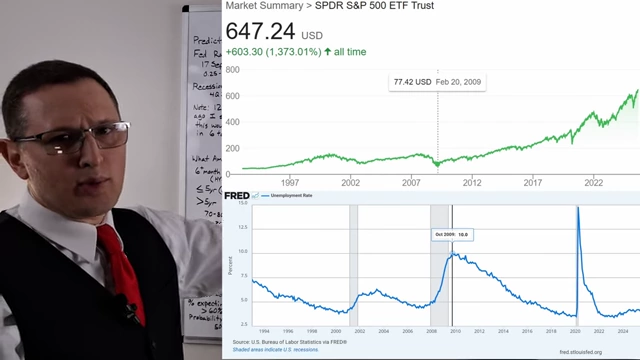
S&P 500 ETF Trust vs. Unemployment Rate [ 00:00:46 ] - Lower interest rates generally benefit the stock market by making borrowing easier for consumers and businesses.
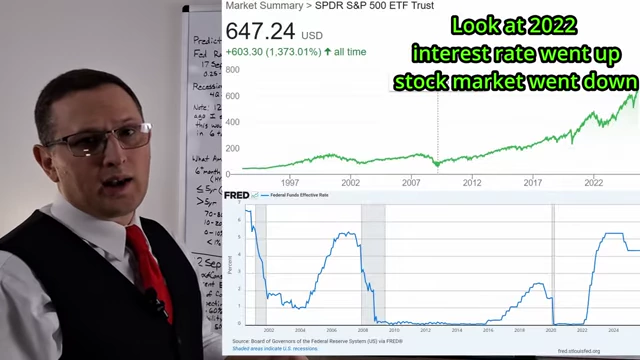
S&P 500 ETF Trust vs. Federal Funds Effective Rate [ 00:00:58 ]
- Stocks tend to bottom out approximately six months before unemployment peaks, indicating their forward-looking nature.
Deteriorating Employment Data [0:59]
Several recent reports indicate a significant weakening in the job market.
- Initial Weekly Unemployment Claims [0:01:01]:
- Reached the highest level since 2021, marking a four-year high, with 263,000 new applicants.
News Release: Unemployment Insurance Weekly Claims [ 00:01:10 ] - A quarter of all unemployed individuals have been out of work for over six months, suggesting increasing difficulty in finding new employment.
- Reached the highest level since 2021, marking a four-year high, with 263,000 new applicants.
- Consumer Expectations [0:01:25]:
- A New York Fed survey revealed that consumer expectations for inflation are rising, while the ease of finding a job has hit its worst record since the survey began in 2013.
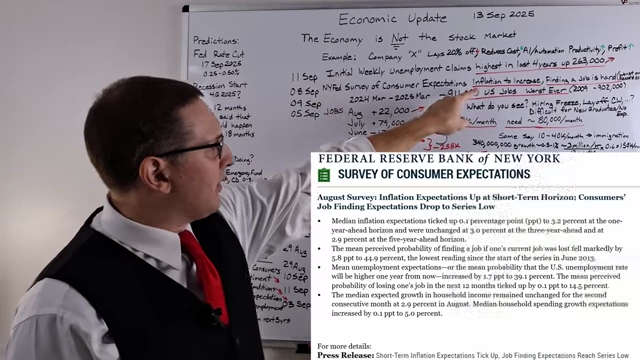
Federal Reserve Bank of New York: Survey of Consumer Expectations [ 00:01:31 ] - New graduates and individuals in the tech sector face particular challenges, with AI displacing many positions.
- The University of Michigan's Survey of Consumers shows sentiment, economic conditions, and consumer expectations are all significantly down (over 20-30% in some categories).
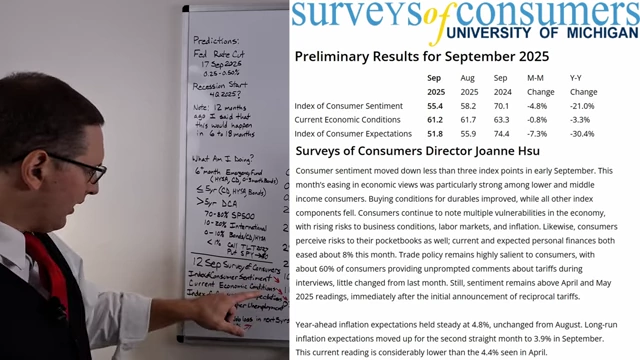
University of Michigan Survey of Consumers - September 2025 [ 00:02:24 ] - Over 60% of the population expects higher unemployment in the next year, and 50-60% anticipate losing their job within five years.
Chart: Consumer Expectations for Rising Unemployment and Job Loss [ 00:02:30 ]
- A New York Fed survey revealed that consumer expectations for inflation are rising, while the ease of finding a job has hit its worst record since the survey began in 2013.
- Unprecedented Job Revisions [0:01:48]:
- A revision from March 2024 to March 2025 showed a reduction of 911,000 jobs that were previously thought to exist.
BLS News Release: Current Employment Statistics Preliminary Benchmark [ 00:02:00 ] - This is the largest job revision ever recorded, significantly exceeding the -92,000 revision during the Great Recession of 2009.
- A revision from March 2024 to March 2025 showed a reduction of 911,000 jobs that were previously thought to exist.
- August Jobs Report [0:02:52]:
- Only 22,000 jobs were added in August 2025.
- June 2025 job numbers were revised down to a net loss, marking the first month with job losses in several years.
- The average number of jobs added per month over the last four months is approximately 27,000, far below the estimated 80,000-100,000 needed monthly to keep pace with population growth.
- Rising Unemployment Rate [0:05:23]:
- The overall unemployment rate increased to 4.3%, up from 4.0-4.2% since May 2024.
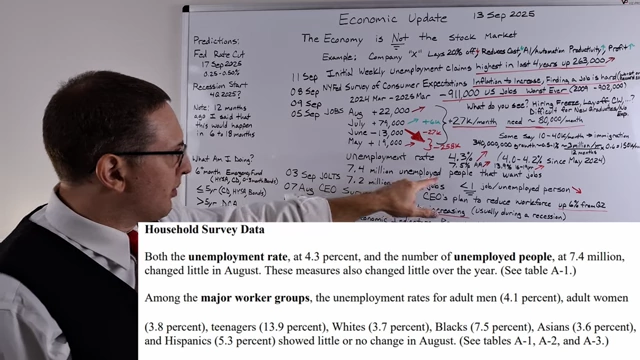
Household Survey Data: Unemployment Rate and Unemployed Persons [ 00:06:10 ] - Specific demographics show higher and rising unemployment: African-Americans are at 7.5%, and younger people (16-19 years old) are at 13.9%. These groups often experience increased unemployment first during economic downturns.
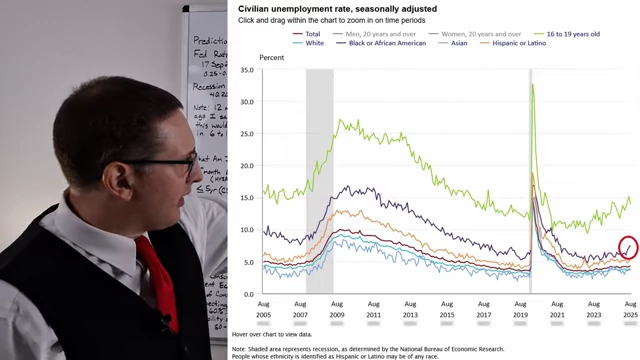
Civilian Unemployment Rate by Demographic Groups [ 00:05:49 ]
- The overall unemployment rate increased to 4.3%, up from 4.0-4.2% since May 2024.
- Job Openings vs. Unemployed Persons (JOLTS) [0:06:08]:
- There are 7.4 million unemployed individuals seeking jobs but only 7.2 million reported open jobs.
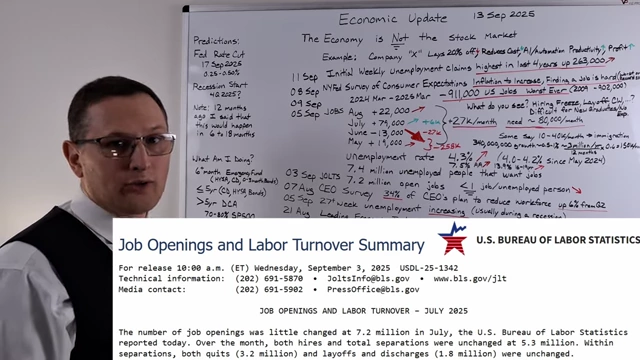
BLS News Release: Job Openings and Labor Turnover Summary (JOLTS) [ 00:06:23 ] - The presenter questions the actual number of "real" job openings, implying many might be "ghost jobs" that companies are not actively or quickly filling.
- There are 7.4 million unemployed individuals seeking jobs but only 7.2 million reported open jobs.
- CEO Sentiment on Workforce [0:06:52]:
- A recent CEO survey indicated that 34% of CEOs plan to reduce their workforce, an increase from 28% in the prior quarter, signaling more layoffs are anticipated.
- Major companies such as UPS, Dell, Nissan, Intel, Microsoft, HBC, Chevron, DHL, BP, and Audi have announced layoffs in 2025.
Leading Companies That Announced Layoffs in 2025 [ 00:07:09 ]
- Long-Term Unemployment [0:07:24]:
- The rate of individuals unemployed for 27 weeks or longer continues to increase, typically a lagging indicator of a recession.
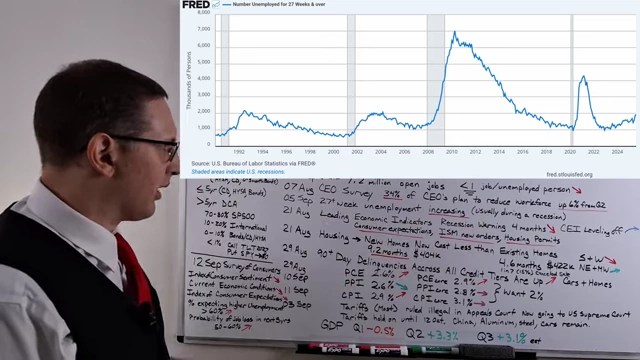
FRED Chart: Number of Persons Unemployed for 27 Weeks and Over [ 00:07:30 ]
- The rate of individuals unemployed for 27 weeks or longer continues to increase, typically a lagging indicator of a recession.
Economic Indicators and Housing Market [0:07:37]
Broader economic signals and the housing market show signs of distress.
- Leading Economic Indicators (LEI) [0:07:37]:
- The LEI has shown a recession warning for four consecutive months.

The Conference Board Leading Economic Index (LEI) [ 00:07:39 ] - The Coincident Economic Indicator (CEI) is leveling off, which often occurs just before a recession begins.
- The LEI has shown a recession warning for four consecutive months.
- Housing Market Trends [0:08:20]:
- New Homes Inventory: The supply of new homes stands at 9.2 months, significantly above the 6 months considered a balanced market, creating a buyer's market.

Census Bureau: For Sale Inventory and Months' Supply of New Houses [ 00:08:38 ] - Builders are offering incentives and reducing prices, leading to fewer new construction permits being pulled.
- Existing Homes: Inventory is at 4.6 months, with a median price of $422,400.
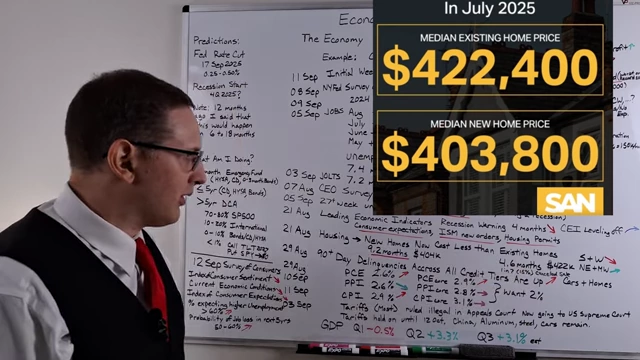
Median Existing and New Home Prices (July 2025) [ 00:08:59 ] - Regional variations exist, with prices dropping in the South and West but remaining stable or rising in the Northeast and Midwest.
- Canceled Contracts: Approximately 15% of pending home sales contracts are being canceled before closing.
- New Homes Inventory: The supply of new homes stands at 9.2 months, significantly above the 6 months considered a balanced market, creating a buyer's market.
Debt Delinquencies and Inflation [0:09:28]
Rising debt issues and persistent inflation add to economic concerns.
- 90+ Day Delinquencies [0:09:28]:
- Delinquencies on loans over 90 days past due are increasing across all credit tiers, primarily for auto loans and mortgages.
Late Stage Delinquency Rate by Credit Tier [ 00:09:29 ] - While some headline news reports hundreds of percent increases for high credit scores, the overall average increase from last year is about 10-20%.
- Delinquencies on loans over 90 days past due are increasing across all credit tiers, primarily for auto loans and mortgages.
- Inflation Metrics [0:10:02]:
- Personal Consumption Expenditures (PCE): 2.6% (core PCE, excluding food and energy, is 2.9%).
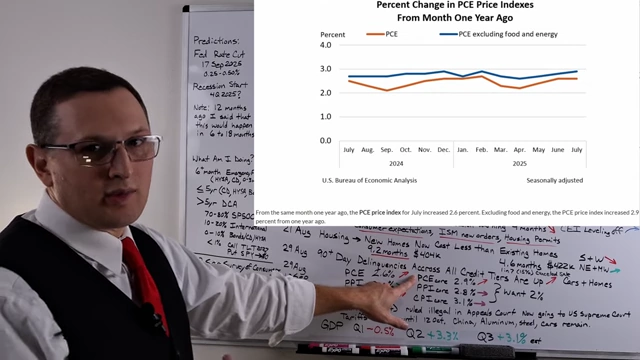
Percent Change in PCE Price Indexes [ 00:10:11 ] - Producer Price Index (PPI): 2.6% (core PPI is 2.8%).
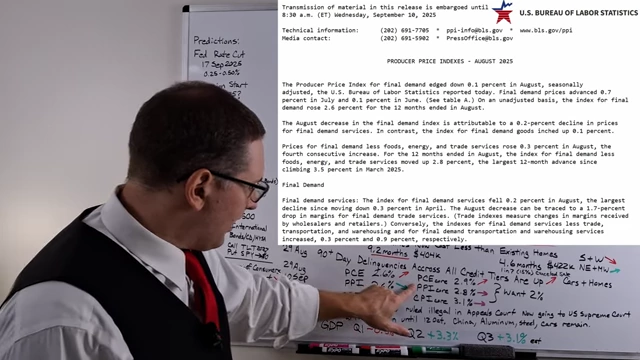
BLS News Release: Producer Price Indexes [ 00:10:23 ] - Consumer Price Index (CPI): 2.9% (core CPI is 3.1%).
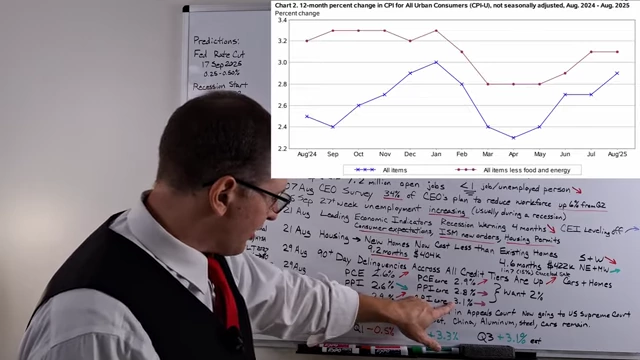
12-Month Percentage Change in CPI for All Urban Consumers [ 00:10:38 ] - All these inflation measures remain above the Federal Reserve's 2% target. The Fed is reportedly abandoning its "flexible average" 2% target and returning to a strict 2% target.
- Personal Consumption Expenditures (PCE): 2.6% (core PCE, excluding food and energy, is 2.9%).
Fed Policy and Recession Prediction [0:10:56]
The Federal Reserve faces a challenging dilemma, influencing the recession outlook.
- Fed's Dual Mandate [0:10:56]: The Fed is tasked with maintaining stable prices (low inflation) and achieving maximum employment.
- Policy Dilemma: With inflation still high and employment showing cracks, the Fed faces a conflict. Reducing interest rates could stimulate employment but potentially exacerbate inflation in the long run (12 months).
- Rate Cut Prediction [0:11:29]: The speaker anticipates the Fed will cut rates at its September 17th meeting, with a 92% probability of a 0.25% cut and an 8% chance of a 0.5% cut.
- Recession Forecast [0:11:46]: The speaker predicts a recession will finally begin in Q4 2025, aligning with a previous 6-18 month forecast made 12 months prior.
Other Economic News & Personal Preparedness [0:12:08]
Additional economic factors and personal financial advice are discussed.
- Tariffs Update [0:12:08]: An appeals court ruled many tariffs illegal (7-4), with the case moving to the Supreme Court.

NPR News: Trump asks Supreme Court to reverse tariffs ruling [ 00:12:15 ] - Existing tariffs remain in effect until October 12th. Tariffs on goods from China, aluminum, steel, and cars are exempt from this ruling as they fall under different statutes.
- Gross Domestic Product (GDP) [0:13:16]: Q1 2025 saw a -0.5% economic slowdown, followed by rebounds in Q2 2025 (+3.3%) and an estimated Q3 2025 (+3.1%).
- What to Do Now (Personal Finance) [0:13:36]:
- Emergency Fund: Build an emergency fund of at least six months of living expenses. A significant portion of Americans cannot handle a $1,000 emergency.
- Savings Vehicles: For funds needed within five years, prioritize safe options like high-yield savings accounts (earning ~3-4.5%) and Certificates of Deposit (CDs, earning ~4.2%) or government bonds.
- Long-Term Investing (>5 years): Utilize dollar-cost averaging for long-term investments. The suggested allocation is 70-80% in S&P 500 index funds, 10-20% in international funds, and 0-10% in bonds, CDs, or high-yield savings.
- Speculation: The speaker mentions personal speculative options trades (a call for TLT bonds in 2027 and a put for SPY in September) but emphasizes this is not investment advice and is considered speculation or "gambling."