The Detrimental Effects of Stress, Burnout, and Hustle Culture on Health and Performance, and Strategies for Prioritizing Well-being
Summary:
This video discusses how modern "martyrdom culture," disguised as heroism, leads individuals to sacrifice their health for professional success, often resulting in severe consequences.
- Health Impacts: Burnout significantly increases heart attack risk. Working over 55 hours/week dramatically elevates stroke and heart attack risks.

Burnout significantly increases the risk of cardiovascular disease by 78% [ 00:14:29 ] 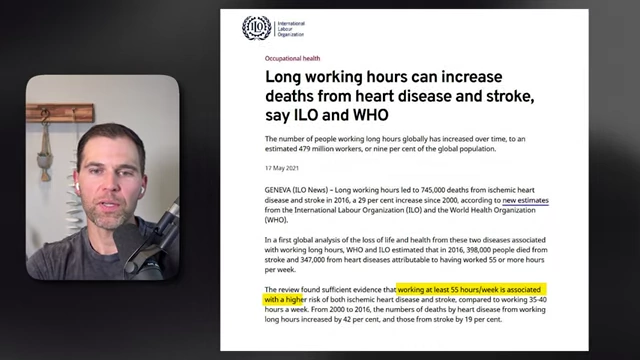
Long working hours increase deaths from heart disease and stroke [ 00:14:49 ] - Performance Decline: Sleep deprivation impairs decision-making, reduces charisma, and lessens productivity. Poor diet and lack of exercise also lead to increased absenteeism and cognitive decline.
- Relationships & Well-being: Overwork strains personal relationships and reduces overall happiness.
- Reclaiming Agency: The solution is to redefine success by prioritizing health, treating practices like sleep and exercise as non-negotiable "work."
- Practical Strategies: Establish rigid morning and evening routines, plan travel around health, and use metrics like resting heart rate to manage stress.
- Cultural Shift: By choosing health, individuals not only improve their own lives but also contribute to a societal shift that supports well-being over self-destruction.
Martyring Yourself for Success [03:11]
- The Myth of Health Sacrifice for Success: Bryan Johnson and Dr. Mike Mallin discuss the widespread belief that compromising health leads to greater professional success. - Bryan's experience: He believes he would have been more successful at his company, Braintree, if he had prioritized his health. - Dr. Mike's experience: He shares a similar experience with burnout in emergency medicine, a field where physicians are implicitly expected to push themselves to the limit, often neglecting personal health. - Societal expectation: This self-sacrificing behavior is a pervasive societal expectation across many professions, not just entrepreneurship or medicine. - Entrepreneurship culture: Expected sacrifices include excessive international travel, minimal sleep (3-4 hours per night), neglected exercise routines, and consuming junk food, all justified by metrics like climbing revenue, increasing employee count, or raising more money. - Misguided systems: Current societal systems encourage detrimental health practices, leading to a "spectacular failure" for individual health, company health, and overall well-being. - Life expectancy for medical professionals: Emergency room doctors, like Dr. Mike, have a significantly lower life expectancy (around 59 years) compared to the average human, a fact often not disclosed upfront.
- The Illusion of Progress: Bryan describes how individuals become "pawns" disposable for the system's progress, compensating by seeking "trophies" of success (power, wealth, status) which are merely a coping mechanism for being martyrs.
- Youthful Perspectives: Kate Tolo, being 29, shares her experience in the New York startup and fashion communities, where there's pressure to boast about overwork and a social acceptance of unhealthy behaviors like going out and smoking.
- The "Sloppy Hardware/Software" Analogy: Bryan argues that founders, who strive for efficient code and hardware, paradoxically run "sloppy software and hardware" (their own bodies and minds) by not prioritizing health. - Fear of falling behind: People struggle to prioritize health because they fear falling behind competitors who are willing to "martyr" themselves, even if those efforts are unproductive.
Evidence: Overwork Will Kill You [15:50]
- Four Key Evidences Against Overwork: Dr. Mike Mallin outlines four statements supported by evidence. 1. Overwork will kill you. 2. Working too much destroys your relationships. 3. All-nighters and sleep disruption cause heart disease and diabetes. 4. Sleep disruption and overwork make you a bad leader.
- Burnout and Cardiovascular Risk:
- A 2022 meta-analysis found that burnout increases the risk of heart attack by a dramatic 78%.
[00:14:29] - This risk is substantial, often exceeding the impact of many other health interventions.
Burnout significantly increases the risk of cardiovascular disease by 78% [ 00:14:29 ] - Long Working Hours and Mortality:
- A study revealed that working beyond 55 hours per week contributed to approximately 800,000 deaths from stroke and heart disease globally in 2016.
[00:14:49] - Individuals working more than 55 hours per week had a 35% higher risk of stroke and a 17% higher risk of death from heart attacks.
Long working hours significantly increase deaths from heart disease and stroke [ 00:14:49 ] - Debunking the "Trade-Off" Myth: - The idea that one can sacrifice health for short-term success (e.g., in their 20s) with plans to "reverse the damage" later (in their 30s or 40s) is fundamentally flawed. - Neglecting health immediately leads to lower performance, damaged social relationships, and reduced overall happiness and quality of life.
Sleep and Decision Making (Studies) [20:04]
- Impact on Leadership and Productivity:
- Sleep-restricted CEOs make 29% more risky errors in lab simulations, highlighting immediate negative impacts on leadership effectiveness.
[00:18:31] - Adequate sleep can lead to an increase of two extra productive hours per week for workers. - Leaders who are sleep-deprived are perceived as less charismatic, make poorer decisions, and are less effective at leading their teams.
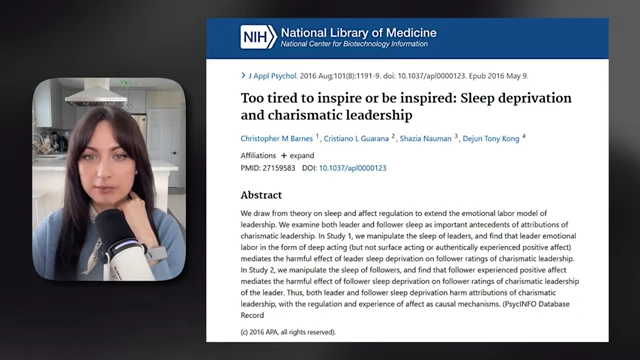
Research on sleep deprivation affecting charismatic leadership [ 00:18:35 ] - Real-World Examples of Impaired Judgment:
- Judicial Decisions: A study of Israeli judges showed a stark difference in decision-making based on fatigue levels. Judges granted 65% parole in the morning when rested, but this dropped to 0% right before lunch, demonstrating how critical decisions are influenced by physiological state.
[00:19:07]

Study on how extraneous factors influence judicial decisions [ 00:19:08 ] [00:19:16] - Personal Anecdotes: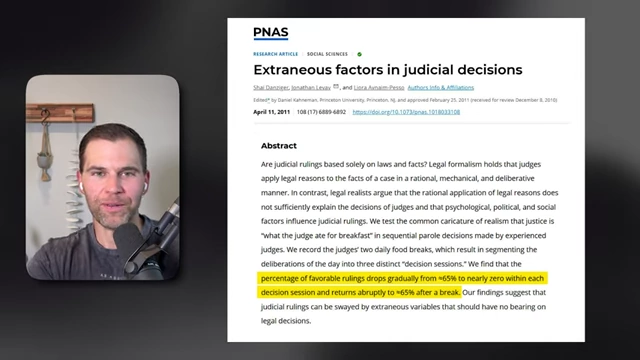
Graph showing that the percentage of favorable judicial rulings drops over time due to fatigue [ 00:19:18 ] - Kate Tolo now avoids having difficult conversations after 5 PM due to her own recognized decrease in emotional stability and increased reactivity when tired.
- Dr. Mike Mallin and his wife coined the term "night shifted" for his state of irritability and pessimism after long emergency room night shifts, leading them to avoid difficult conversations during those times. This illustrates the lack of empathy and increased reactivity that comes with sleep deprivation.
Physical Fitness and Diet (Studies) [25:54]
- Physical Fitness and Work Attendance: - There is a direct correlation between physical fitness and absenteeism. - Individuals in the top 25th percentile of physical fitness miss approximately 2 work days per year on average. - Those in the bottom 25th percentile miss about 6 work days per year. - This demonstrates that investing in physical fitness is a direct investment in one's ability to consistently be present and work.
- Diet and Cognitive Performance: - Cognitive performance tracks almost directly with diet quality. - Consumption of ultra-processed "convenience" foods has a negative impact. - Every serving of ultra-processed food consumed per day increases the risk of dementia by about 13%. - This highlights how diet affects not just long-term health (like dementia risk) but also daily cognitive performance and decision-making.
Treating Health Like Religion [28:24]
- Modern "Martyrdom" as a New Religion: - Historically, religion was a powerful motivating force, leading people to endure hardship for an afterlife reward. - Bryan argues that modern "martyrdom culture" is equally, if not more, zealous. The "prize" in this new "religion" is intensely identified with status, power, and wealth. - People are willing to "suicide themselves even in a slow-mo fashion" to achieve these prizes, becoming "transfixed in a zombie-like fashion" and losing control over themselves. - This phenomenon reflects a societal system where the system's progress becomes the priority, and individuals are disposable "pawns."
- Shifting the Paradigm to Health as Priority: - The "Don't Die" philosophy proposes making existence itself the priority, thereby preventing individuals from being arbitraged or disposable for system gains. - Analogy to Athletes: No one disputes that Olympic or professional athletes must prioritize their physical bodies (sleep, nutrition, avoiding excessive travel) to achieve peak performance, as their bodies are their primary asset. - Application to Professionals: Entrepreneurs and professionals, who compete with their minds, emotions, and judgment, often fail to apply the same logic to their cognitive and emotional "assets." There's a "disconnect of cognition" where they don't pair ideal performance with rigorous health. - Cultural Shift and Investor Mindset: Bryan believes the culture is shifting, and the "martyrdom culture" is increasingly seen as detrimental. Investors are beginning to care about and evaluate the health of founders when making investment decisions, as a healthy founder is perceived as a less compromised and therefore better investment.
Tips for Balancing Work and Health [33:30]
- Acknowledging the Challenge: Many people feel the pain of modern culture and desire an exit path but feel trapped by external expectations. The goal is to provide social permission and practical strategies.
- Kate's Method: "Treat Sleep Like Work" [33:17]:
- This reframing helps individuals who are accustomed to a 24/7 work mindset.
- Sleep is no longer seen as a luxury or "slacking off" but as a critical component of one's "job" and productivity.
- Practical Applications:
- Morning Routine Block-Out: Schedule health practices (e.g., exercise, meditation) in the morning and avoid scheduling work before a certain time (e.g., Bryan's calendar after 10 AM).
- Prioritize Sleep Allocation: By default, allocate time for sleep first, and then plan social events or work around it, rather than fitting sleep into leftover time.
- Conscious Travel Planning: Be "sober" about the impact of travel on health. Book flights that align with sleep and morning routines (avoid red-eye flights) to minimize disruption.
- Dr. Mike's Method: "Compassionate Depersonalization" [34:35]: - This approach is effective for individuals who struggle with self-judgment or anxiety around sleep. - Instead of asking "Should I go to bed right now?", reframe it as "Would my child or my patients want their doctor to go to bed right now?" - This allows for empathy and compassion towards self-care that might otherwise be difficult to access.
- Bryan's Method: "System-Level Decisions" [42:41]: - "Morning Bryan" (high in willpower and rational thought) makes systemic decisions for "7 PM Bryan" (worn down, out of willpower, prone to poor choices). - This involves pre-committing to routines and boundaries that safeguard health, preventing impulsive, unhealthy choices when willpower is low.
- Importance of Non-Negotiables [40:53]: - Establish clear, unwavering boundaries for key health practices (e.g., specific bedtimes, exercise routines). - These "guardrails" prevent individuals from rationalizing deviations from their health goals, especially for highly successful, type A personalities who are skilled at convincing themselves. - Examples: "I am in bed by 10 PM," "I am up an hour before the kids to meditate and journal," "I don't eat junk food." These foundational habits are crucial, even for those with complex lives.
Resting Heart Rate Before Bed [43:58]
- Universal Health Metric: Resting heart rate before bed is presented as a universally applicable metric that anyone can use to build life systems around, regardless of their complex schedules.
- Impact of Rumination: Overthinking, worrying, or trying to solve "world problems" before bed (rumination) significantly increases resting heart rate by 5 to 25 beats per minute.
- Consequences: This elevated heart rate negatively impacts sleep quality, recovery, and subsequent willpower, creating a detrimental cascade.
- Actionable Strategy: Individuals must learn to reconcile and minimize rumination before sleep to optimize their resting heart rate and overall health.
Protecting Your Agency [47:06]
- Claiming Personal Power: The overarching message is to actively resist the societal pressure of "martyrdom culture" and reclaim one's personal power and agency.
- Cascading Negative Effects of Martyrdom: Succumbing to this culture ruins personal power, enslaves individuals within systems not of their choosing, destroys willpower, dramatically increases cardiovascular risk, makes leaders less charismatic, worsens insulin sensitivity, and leads to general physical and mental decline.
- Shifting the Zeitgeist: By embodying healthy choices and prioritizing well-being, individuals contribute to a broader cultural shift. When more people prioritize health, it creates "societal permission" for others to do the same, making healthy choices the norm rather than an outlier behavior.
- Experiential Learning and Confidence: Once an individual experiences the tangible benefits of prioritizing health—becoming a better leader, entrepreneur, professional, parent, child, friend, or coworker—they gain firsthand conviction. This personal experience empowers them to confidently advocate for health-first approaches.
- Ongoing Challenges: Even with optimized routines, external factors like frequent international travel (e.g., Bryan's upcoming trips to China and the Middle East) can still pose significant health challenges, emphasizing the continuous need for vigilance, adaptation, and conscious decision-making to protect one's health and agency.