Why AA Batteries Haven't Improved and Why That's Okay
- AA batteries, unlike modern lithium-ion batteries in phones and cars, have seen only a modest 20-30% energy capacity increase since the 1990s.
- The primary reason for this stagnation is the need to maintain a consistent 1.5-volt output and the physical AA size, which limits the integration of more advanced chemistries like lithium-ion.
- Early AA batteries were zinc-carbon (acidic), evolving to alkaline (basic) with potassium hydroxide, which required engineering changes to the battery's casing but maintained the standard voltage and size.
- Rechargeable options like Nickel-metal hydride (NiMH) also plateaued in performance around 2005.
- Lithium-ion batteries naturally operate at 3.6-3.7 volts, which is too high for devices designed for 1.5V AAs and would require complex, expensive, and space-consuming voltage regulators and protection circuitry within the AA form factor.
- Ultimately, the market has self-regulated: energy-hungry devices now come with integrated lithium-ion batteries, while low-drain devices like remotes and toys continue to use inexpensive, sufficient AA batteries, making a drastically improved, more expensive AA battery unnecessary for most use cases.
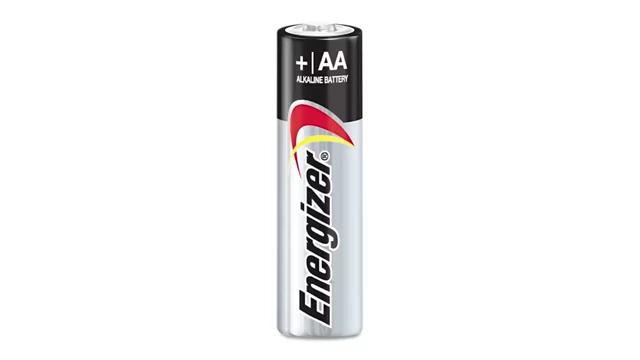
An Energizer AA alkaline battery [ 00:00:15 ]
The Stagnation of AA Batteries [0:00:00]
The video begins by highlighting the speaker's frustration with AA batteries, which despite technological advancements in other areas (like phones and cars), seem to have remained largely unchanged in size, shape, price, and lifespan since his childhood.
- Initial Observation [0:00:00]
- AA batteries appear to be stuck in time, still powering remotes, flashlights, and toys with the same "mediocre lifespan."
- This contrasts sharply with the significant improvements seen in car and phone batteries.
- Performance Comparison [0:01:12]
- A high-end AA battery today holds only about 20-30% more energy than one from the 1990s.
- In the same period, lithium-ion batteries (used in phones and cars) have improved fivefold in terms of energy per kilogram.
An Energizer AA alkaline battery [ 00:00:15 ] 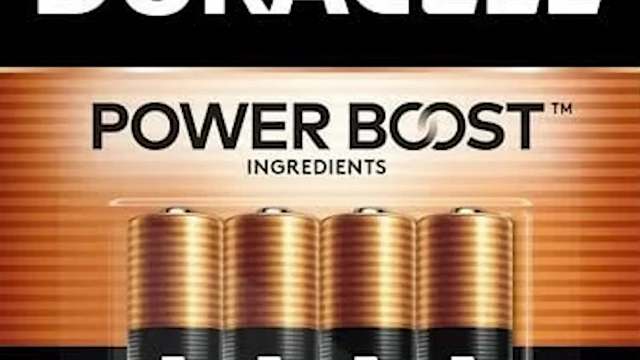
Duracell Power Boost batteries, an example of a "high-end" AA battery [ 00:01:14 ]
Historical Evolution of AA Battery Chemistry [0:01:58]
The speaker explains that AA batteries have undergone chemistry changes over the years, but these changes were constrained by the need to maintain the same physical dimensions and voltage output.
- Zinc-Carbon Cells (Acidic) [0:02:16]
- These were the original AA battery type, using an acidic electrolyte.
- Components included a carbon current collector, manganese dioxide as the positive electrode, and zinc as the negative electrode.
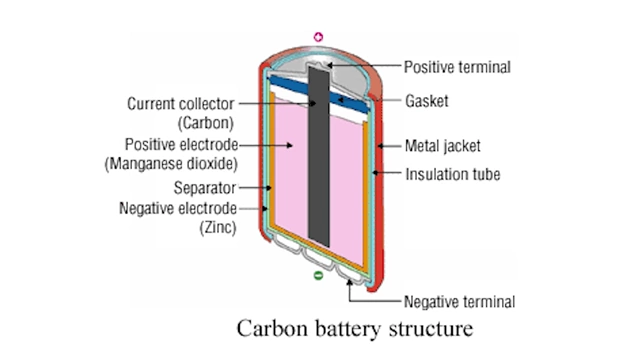
A diagram illustrating the internal structure of a carbon battery [ 00:02:18 ]
- Shift to Alkaline Batteries (Basic) [0:02:26]
- A significant transition occurred to alkaline batteries, which use a basic electrolyte like potassium hydroxide.
- This change required improvements to the battery's casing to handle increased internal pressure and expansion during use.
- Crucially, the size and shape of the battery, as well as its 1.5-volt output, had to remain identical to ensure compatibility with existing devices.
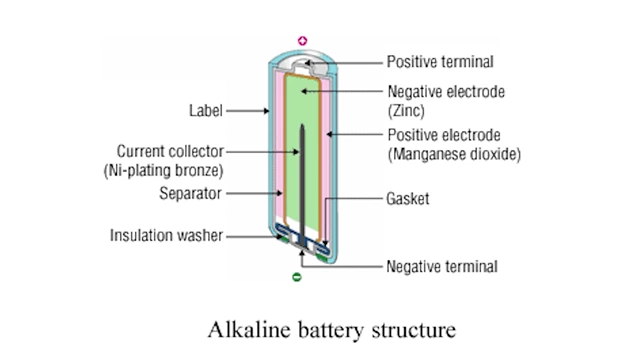
A diagram illustrating the internal structure of an alkaline battery [ 00:02:13 ]
- Rechargeable AA Options [0:03:22]
- Other chemistries were developed for rechargeable AA batteries, such as nickel-cadmium (Ni-Cd) and nickel-metal hydride (NiMH).
- NiMH batteries represented a leap forward, offering similar energy capacity to alkalines and the ability to be recharged hundreds of times.
- However, even high-capacity NiMH AA batteries have shown little improvement since around 2005, with some manufacturers even exaggerating their capabilities.

A close-up of a NiMH rechargeable AA battery [ 00:03:30 ]
The Lithium-Ion Conundrum for AA Batteries [0:05:47]
The core problem preventing AA batteries from adopting lithium-ion technology is a fundamental incompatibility in voltage and the practical limitations of fitting the necessary components into the AA form factor.
- Inherent Voltage Mismatch [0:05:50]
- Lithium-ion chemistry naturally produces 3.6-3.7 volts, which is more than double the 1.5 volts required by devices designed for traditional AAs.
- Device Compatibility and Legacy [0:06:00]
- Despite many older devices being obsolete, a continuous stream of new, low-power devices still uses the 1.5V AA standard, creating a persistent demand.
- Introducing 3.6V lithium-ion batteries in the AA form factor would damage these existing devices, leading to consumer dissatisfaction.

An open Wii remote, showing the battery compartment designed for AA batteries [ 00:03:00 ]
- Technical Solutions and Their Drawbacks [0:06:53]
- It is technically possible to incorporate lithium-ion cells into an AA shape by adding a voltage regulator to step down the voltage to 1.5 volts.
- This regulator, along with necessary protection circuitry (lithium-ion batteries are more temperamental), takes up significant internal space.
- The space taken by these components reduces the room for the actual energy-storing chemistry, and they add considerable cost, resulting in an AA battery that might offer more energy but is significantly more expensive.

A disassembled lithium-ion AA battery, showing the voltage regulator circuit built into its cap [ 00:07:00 ] 
A package of Energizer Ultimate Lithium AA batteries, an example of a lithium AA battery [ 00:07:39 ]
The Practical Reality and Market Forces [0:07:41]
The current state of AA batteries is not a failure but a rational market outcome, where different battery technologies serve different needs.
- Divergence in Device Design [0:07:46]
- Energy-hungry devices (e.g., cameras, high-power lights) are now designed with integrated lithium-ion batteries and dedicated chargers.
- Low-load devices (e.g., television remotes, clocks, simple toys) continue to use AA batteries because their power demands are minimal, and replacement is infrequent (every year or two).

A product page for a storytelling dragon toy, an example of a low-drain device [ 00:06:45 ]
- AA as a Commodity [0:08:33]
- AA batteries are a low-cost, low-margin, high-volume commodity.
- Developing a "magic" AA battery that lasts five times longer but costs ten times more is not a viable business model for battery manufacturers, as customers would simply buy fewer units.
- An Optimal System [0:09:07]
- The current situation is presented as an optimal solution: products requiring significant power integrate high-performance lithium-ion batteries, while those with minimal power needs continue to use the economical and readily available AA standard.
- This specialization means that AA batteries are not "sucking"; they are simply fulfilling their appropriate role in the market, a role they are likely to continue to fill for decades.