iPhone 16 Pro Camera Test: JPEG-XL Compression, Ultra-Wide Sensor, and Main Camera Performance Compared to iPhone 15 Pro and Canon R5
This video comprehensively tests the iPhone 16 Pro's camera capabilities against the iPhone 15 Pro and a Canon R5, focusing on real-world landscape and macro photography.
- The most significant, undisclosed upgrade is the new JPEG-XL compression for raw images, which dramatically reduces file size (from 75-100MB to 20-50MB) with virtually no noticeable loss in detail, even at high zoom levels.
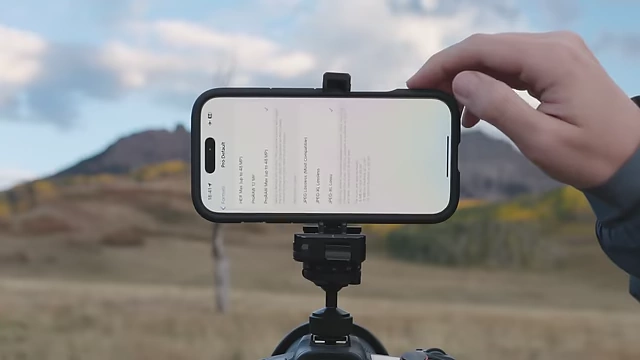
iPhone 16 Pro settings menu showing different ProRAW formats including JPEG-XL options. [ 00:00:42 ] - The iPhone 16 Pro's upgraded 48MP ultra-wide sensor shows improved detail in the center of the frame compared to the 15 Pro's 12MP sensor, though lens distortion at the edges remains similar to previous models.
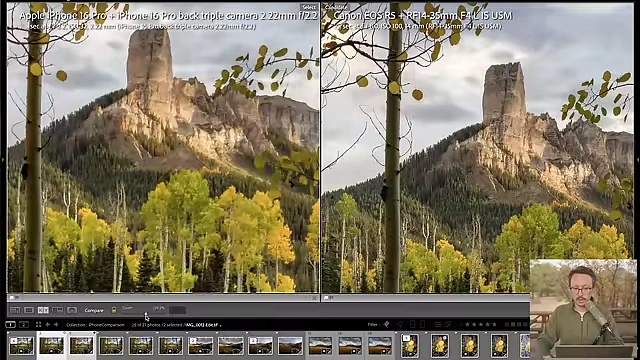
A zoomed-in comparison of the iPhone 16 Pro (left) and Canon R5 (right) focusing on the center of an ultra-wide landscape image. [ 00:16:58 ] - The main camera of the iPhone 16 Pro performs exceptionally well in good lighting, closely matching the Canon R5, but struggles with detail and noise in low-light conditions.
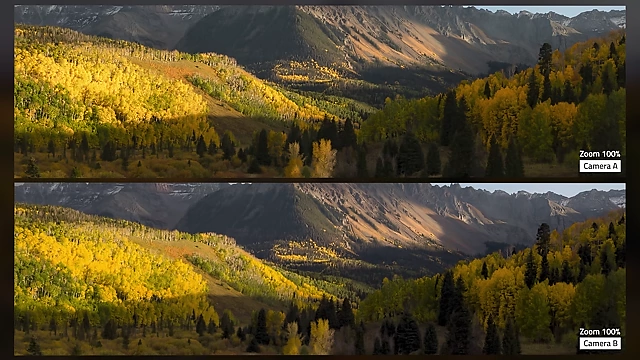
Zoomed-in comparison of the iPhone 16 Pro (bottom) and Canon R5 (top) during sunset, showing similar detail in well-lit areas. [ 00:07:29 ] - New features like the camera control button and photographic styles are acknowledged but not fully evaluated due to testing methodology.
- The iPhone 16 Pro can capture impressive Aurora Borealis photos, making it a viable tool for sharing, though not for professional printing due to quality limitations compared to a dedicated camera.
Introduction [0:00]
The video introduces the iPhone 16 Pro's camera features, highlighting a significant, undisclosed upgrade for photographers. The presenter, a full-time landscape photographer, compares the new iPhone to his professional Canon R5 camera in real-world scenarios.
Ultra-Wide Camera Landscape Test [1:09]
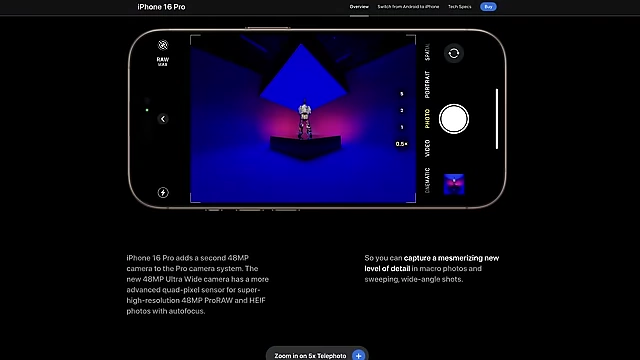
The first test focuses on the iPhone 16 Pro's upgraded ultra-wide camera, which now features a 48-megapixel sensor, compared to the iPhone 15 Pro's 12-megapixel sensor and a Canon R5 at 14mm.
- Testing Methodology:
- All images were shot in Raw to capture maximum data.
- A blind test format was used, labeling cameras A, B, and C to prevent bias.
- The complex composition included varied elements like Aspen leaves, trees (for distortion testing), and a famous rock formation (Cathedral Rock) under challenging dynamic light conditions.
- The presenter had to manually hold both iPhones due to the ultra-wide field of view to avoid capturing the camera setup.
- People and a car in the background were Photoshopped out to test the data recovery capabilities of the larger sensors.
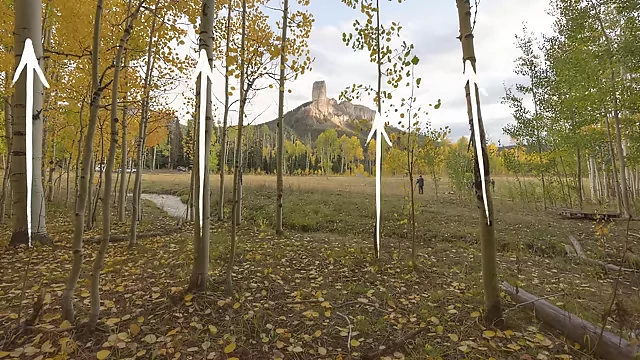
The wide-angle landscape test scene, highlighting the Aspen trees used to test lens distortion. [ 00:04:08 ] - The raw settings on the iPhone 16 Pro, enabling 48MP capture.
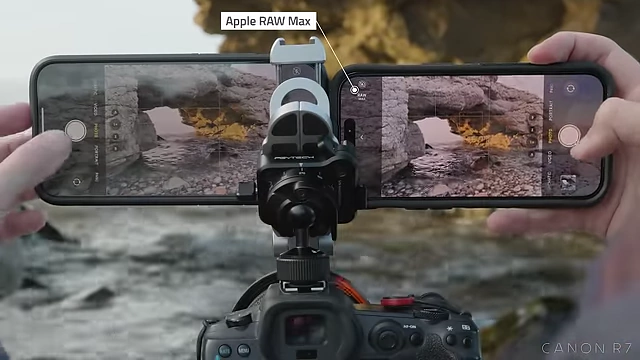
The settings screen of the iPhone 16 Pro's camera, showing the "ProRAW Max (up to 48 MP)" option selected, which indicates raw image capture. [ 00:02:48 ]
- Results (16 Pro vs. R5) [16:39]
- Sharpness: The Canon R5 image (Camera C) was noticeably sharper in the center of the frame, with better detail in trees, while the 16 Pro (Camera A) was slightly softer.
A zoomed-in comparison of the iPhone 16 Pro (left) and Canon R5 (right) focusing on the center of an ultra-wide landscape image, showing the R5's sharper detail. [ 00:16:58 ] - Edge Performance: Both the R5 and 16 Pro showed a decrease in sharpness towards the edges, but the R5 maintained better detail. The presenter suggests this is a limitation of the iPhone's lens design rather than the sensor.
- Sharpness: The Canon R5 image (Camera C) was noticeably sharper in the center of the frame, with better detail in trees, while the 16 Pro (Camera A) was slightly softer.
- Results (16 Pro vs. 15 Pro) [18:26]
- Center Sharpness: The iPhone 16 Pro (Camera A) showed substantial improvement in detail and sharpness in the center compared to the 15 Pro (Camera B), despite the 15 Pro's image appearing "overly sharpened" by its processing.
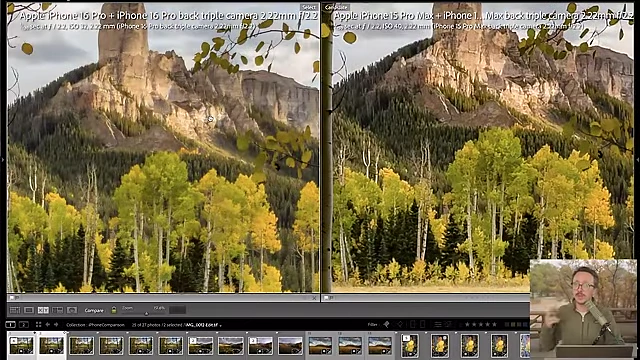
A zoomed-in comparison of the iPhone 16 Pro (left) and iPhone 15 Pro (right) for the ultra-wide landscape shot, zoomed into the center, showing the 16 Pro's improved detail. [ 00:18:38 ] - Edge Performance: Surprisingly, there was less noticeable detail difference between the 16 Pro and 15 Pro at the edges, particularly in shadowed areas, indicating that the older 15 Pro's 12MP sensor still held up well in those less ideal regions due to lens limitations common to both iPhones.
- Center Sharpness: The iPhone 16 Pro (Camera A) showed substantial improvement in detail and sharpness in the center compared to the 15 Pro (Camera B), despite the 15 Pro's image appearing "overly sharpened" by its processing.
Main Camera Sunset & Blue Hour Test [5:09]
This test compares the main camera sensor of the iPhone 16 Pro to the Canon R5 under sunset and blue hour conditions, pushing the dynamic range and low-light performance.
- Testing Conditions:
- Shot during sunset with strong dynamic light, then again during blue hour (low light).
- A polarizing filter was used on both cameras to reduce atmospheric haze.
- Results (Sunset) [23:22]
- Overall Quality: The iPhone 16 Pro (Camera B) produced results very similar to the Canon R5 (Camera A) in well-lit areas.
Zoomed-in comparison of the iPhone 16 Pro (bottom) and Canon R5 (top) during sunset, showing similar detail in well-lit areas. [ 00:07:29 ] - Shadows: While impressive, the iPhone showed slight degradation in shadow detail compared to the R5, as expected.
- Printability: The presenter affirmed that the 16 Pro images are good enough for large prints, based on previous year's print tests.
- Overall Quality: The iPhone 16 Pro (Camera B) produced results very similar to the Canon R5 (Camera A) in well-lit areas.
- Results (Blue Hour / Low Light) [24:48]
- Detail Loss: In low light, the iPhone 16 Pro (Camera B) showed a significant loss of detail and mushiness compared to the Canon R5 (Camera A).
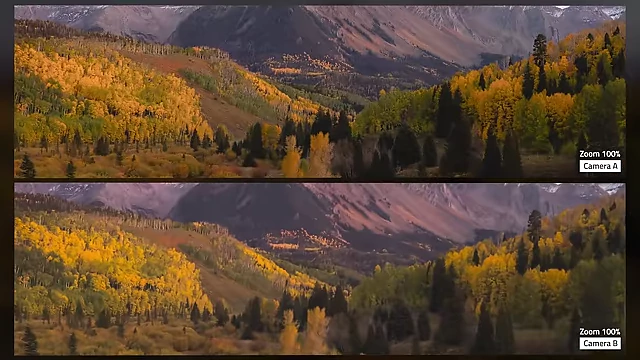
Zoomed-in comparison of the iPhone 16 Pro (bottom) and Canon R5 (top) in low-light (blue hour), revealing significant detail loss on the iPhone. [ 00:07:48 ] - Sensor Limitations: The lower light conditions exposed the limitations of the iPhone's computational photography and sensor in rendering fine details.
- Detail Loss: In low light, the iPhone 16 Pro (Camera B) showed a significant loss of detail and mushiness compared to the Canon R5 (Camera A).
120 FPS 4K Recording [7:53]
Apple has added 120 FPS 4K recording to the iPhone 16 Pro, a feature used to film parts of the video.
JPEG-XL Compression [9:16]
This is presented as the most significant "secret" upgrade. The iPhone 16 Pro introduces new compression methods for raw files (JPEG-XL lossless and lossy) that drastically reduce file sizes without apparent loss of quality.
- Problem Statement: Previous iPhone Pro models produced very large 48MP raw files (75-100 MB), limiting storage and frequent use.
- New Compression Options: The 16 Pro offers three options:
- Most compatible (largest file size, standard raw)
- JPEG-XL lossless (approx. half the size)
- JPEG-XL lossy (approx. one-fourth the size, around 20MB)
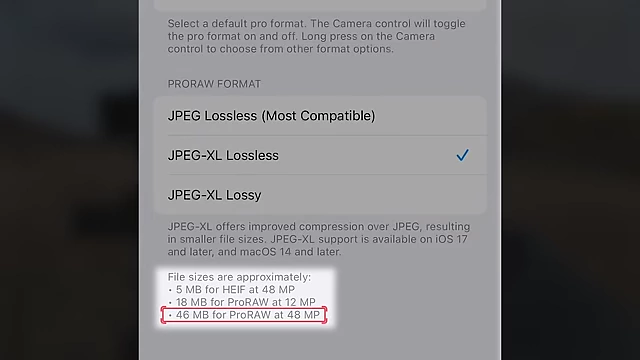
iPhone ProRAW format settings, detailing the approximate file sizes for different compression options: 5MB for HEIF, 18MB for ProRAW at 12MP, and 46MB for ProRAW at 48MP. [ 00:11:33 ]
- Comparison Results [20:23]
- Quality Preservation: Surprisingly, even at extreme zoom levels (e.g., 600-800%), the JPEG-XL compressed files showed virtually no difference in detail or artifacting compared to the uncompressed raw files. In some cases, the compressed versions appeared marginally better.
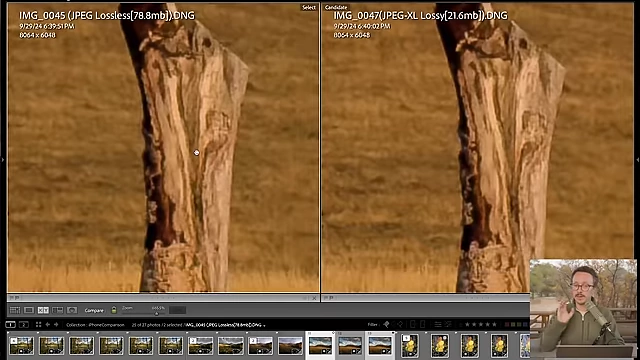
A highly zoomed-in comparison of the uncompressed ProRAW file (left, 78.8 MB) against the smallest JPEG-XL lossy file (right, 21.6 MB), demonstrating no discernible quality loss at high magnification. [ 00:21:58 ] - Implication: This breakthrough allows photographers to shoot raw images much more frequently without worrying about storage, a "game-changer" for mobile photography.
- Apple's Silence: The presenter expresses bafflement that Apple has not publicly highlighted this feature, as it's a major advancement.
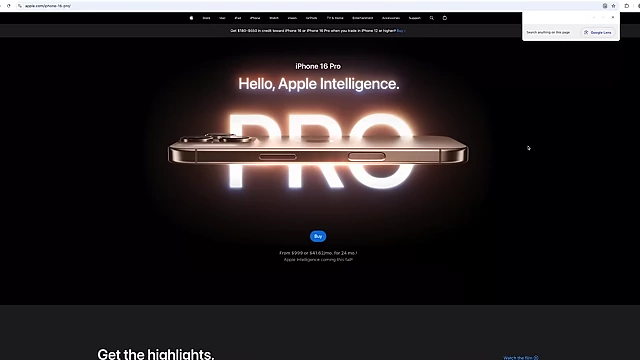
A screenshot of Apple's iPhone 16 Pro website, demonstrating a search for "JPEG XL" yielding no results, highlighting Apple's undisclosed nature of this feature. [ 00:22:40 ]
- Quality Preservation: Surprisingly, even at extreme zoom levels (e.g., 600-800%), the JPEG-XL compressed files showed virtually no difference in detail or artifacting compared to the uncompressed raw files. In some cases, the compressed versions appeared marginally better.
Ultra-Wide Camera Macro Test [12:25]
This test evaluates the macro capabilities of the ultra-wide camera on the 16 Pro, comparing it to the 15 Pro and Canon R5.
- Setup Challenges:
- The Canon R5's minimum focusing distance (200mm) is significantly longer than the iPhones' (20mm), making a direct 1:1 macro comparison difficult.
- The test involved creating a manufactured scene with leaves and water droplets on a log.
- All cameras were shot handheld after initial tripod setup to ensure a fair real-world comparison.
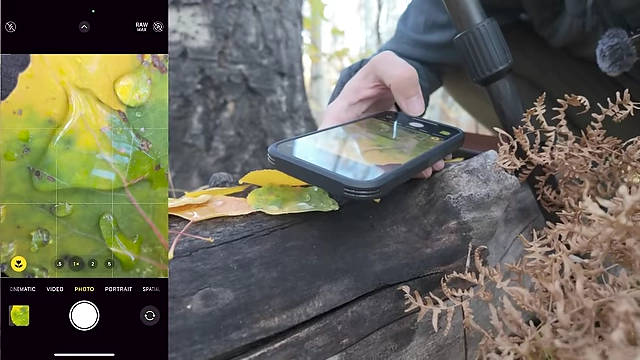
The iPhone's camera interface in macro mode, showing a close-up of a leaf with water droplets, indicating the phone's ability to focus on subjects at extremely close distances. [ 00:14:43 ] 
An extreme close-up macro shot of a yellow leaf with water droplets, taken with the iPhone 16 Pro. [ 00:14:49 ]
- Results (16 Pro vs. R5) [25:54]
- Detail: The 16 Pro (Camera C) performed "really good" in macro, with strong detail in the leaves, though the R5 (Camera B) still offered slightly sharper and clearer results.
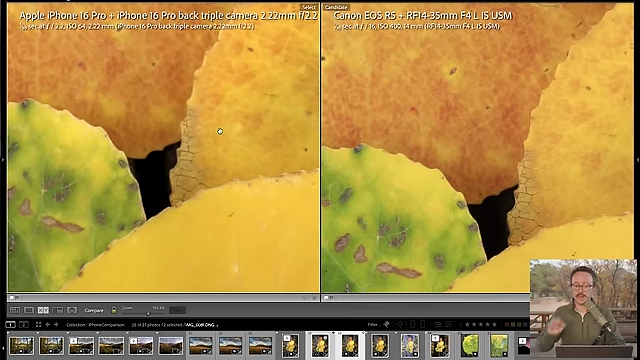
A zoomed-in comparison of macro shots on leaves, comparing the iPhone 16 Pro (left) and Canon R5 (right), showing the R5 has slightly sharper and clearer details. [ 00:26:17 ] - Edge Distortion: Unlike the wide-angle landscape test, the macro images showed significantly less fall-off and distortion at the edges on the iPhone, likely due to the closer subject distance.
- Detail: The 16 Pro (Camera C) performed "really good" in macro, with strong detail in the leaves, though the R5 (Camera B) still offered slightly sharper and clearer results.
- Results (16 Pro vs. 15 Pro) [27:03]
- Overall Performance: The 15 Pro (Camera A), despite its older 12MP sensor, held its own surprisingly well against the 16 Pro (Camera B) in macro.
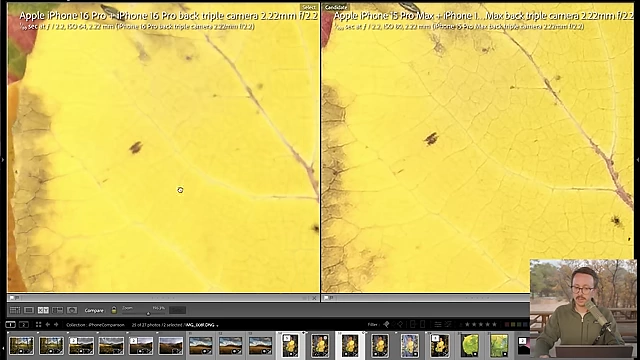
A zoomed-in comparison of macro shots on leaves, comparing the iPhone 16 Pro (left) and iPhone 15 Pro (right), showing comparable detail despite the 15 Pro's older sensor. [ 00:27:17 ] - Sharpening: The 15 Pro's image appeared more sharpened by default, but the overall detail was comparable, suggesting the older sensor's macro capabilities are still quite good.
- Overall Performance: The 15 Pro (Camera A), despite its older 12MP sensor, held its own surprisingly well against the 16 Pro (Camera B) in macro.
Camera Control Button & Photo Styles [28:21]
The video briefly touches upon other new features on the iPhone 16 Pro.
- Camera Control Button: The presenter found it less useful for his specific tripod-based, deliberate shooting style, preferring to tap the screen to avoid camera shake. He acknowledges it might be useful for casual shooters.
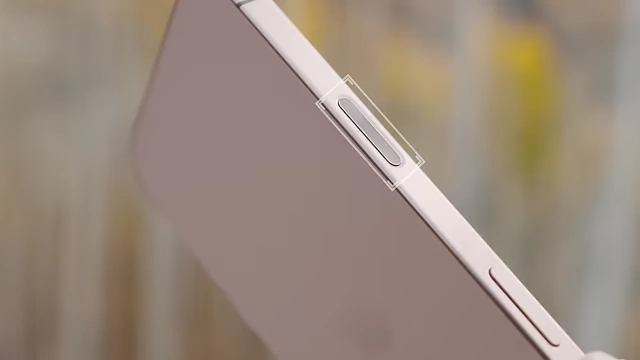
Close-up of the new camera control button on the side of the iPhone 16 Pro. [ 00:00:40 ] - Photographic Styles: While not fully explored in the video, the presenter sees potential if Apple allows more customizability and integration with the control button for quick recipe changes, similar to Fujifilm cameras.
- Unfinished Release: The presenter notes that many advertised features, like the half-shutter press on the control button and AI capabilities, were not yet enabled on release, deeming the phone "unfinished."
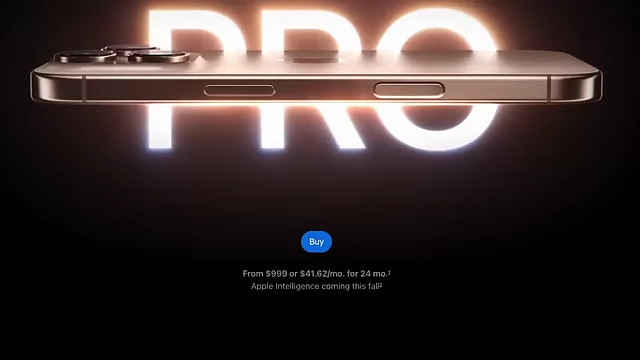
A promotional image for the iPhone 16 Pro, displaying text that says "Apple Intelligence coming this fall," indicating that some features are not yet released. [ 00:29:57 ]
iPhone 16 Aurora Photos! [30:36]
The video concludes with a showcase of Aurora Borealis photos taken with the iPhone 16 Pro's main camera.
- Purpose: These are presented for fun and to demonstrate the phone's impressive capability for capturing such events, rather than a strict quality comparison.
- Performance: The iPhone 16 Pro (left) successfully captures vibrant Aurora colors.
- Limitations: While great for sharing, the images are not suitable for large prints due to inherent noise reduction and less detail compared to a dedicated camera like the Canon R5 (right) with a fast lens. Stars also appear less defined on the iPhone due to noise reduction.
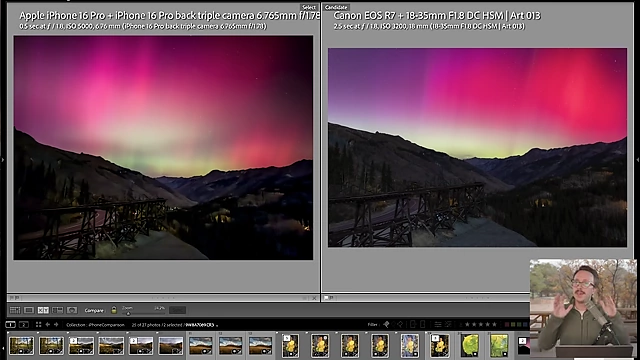
A side-by-side comparison of an Aurora Borealis photo taken with the iPhone 16 Pro (left) and a Canon R5 (right), showing the iPhone's ability to capture vibrant colors but the R5's superior detail. [ 00:30:37 ] - Pro Tip: Use your phone to find the Aurora as it can often detect it better than the human eye in faint conditions.