This video presents a comprehensive system to develop multiple skills efficiently and avoid burnout.
Understanding Skill Acquisition: The process involves an initial period of high effort and low skill (Phase 1: Disorientation), followed by adaptation where effort decreases and skill increases (Phase 2: Adaptation). Many fail by underestimating Phase 1.
Learning Fallacy: Distinguishes between theoretical learning (reading) and actual application, emphasizing that only application contributes to skill development.
Immersion and Focus: Advocates for "effective immersion" to rapidly gain familiarity and "high-grade focus" to maximize learning per unit of effort, while maintaining life balance.
Eliminating Errors: Highlights the importance of identifying and eliminating basic errors, as intuition can mislead beginners.
Project Management: Suggests a "20 hours focused time / 8 weeks minimum" rule for initial projects, and criteria for when to add new projects (when current projects feel effortless).
Strategic Stacking: Introduces advanced tactics like "dual learning" (primary and secondary projects) and "strategic layering" to combine and mature skills for compounded benefits.
Skill Assessment: Encourages defining a desired skill level, understanding different skill curve types, and recognizing diminishing returns on effort for higher mastery levels.
The crossover point where high initial effort transitions to effortless mastery (Cruise Mode)
[
00:09:30
]
The Problem: Many individuals are enthusiastic about developing new ideas, interests, and skills but often find themselves spread too thin.
This leads to numerous unfinished, "half-baked" projects.
There are no tangible useful skills or results despite significant effort.
The lack of progress can lead to feeling stuck and missing opportunities.
The Analogy: Trying to launch multiple planes (projects) from a runway simultaneously results in crashes, burnout, and nothing to show for the effort. Others seem to "cruise" effortlessly with multiple skills.
Attempting too many projects at once leads to multiple failures, akin to planes crashing on a runway
[
00:06:30
]
The speaker lists a variety of areas he has explored, including breakdancing, snowboarding, calisthenics, drone racing, renovations, starting a food business, community building (online and in-person), investment, marketing, sales, coaching, online courses, and piano.
Many of these were pursued concurrently with a 9-to-5 job.
Clients have also worked on diverse goals like lifestyle/hobbies, social media growth, career changes, writing, podcasting, presentations, Web3, business, and AI.
The video will cover how to build effortless skills, stop inefficient learning, practical consistency tricks, eliminating beginner errors, knowing when to quit or double down, prioritizing projects, and when to add new projects.
Key Takeaways:
Stop overcommitting.
Learn advanced focus systems (high-grade and low-grade focus).
Avoid the "learning fallacy" (an obvious learning trap).
Understand how intuition sabotages beginners ("newbie naivety").
Change limiting beliefs and use unconscious processing for faster learning.
Learn fast while maintaining work-life balance.
Make the process enjoyable.
Advanced Tactics: How to combine, multi-thread, and create extreme multi-skill value for rapid progress and results (only after foundation work is complete).
The Problem: Taking on too many projects and trying to learn everything at once.
This leads to "crashes" before making meaningful progress.
The Key: Sequential Learning:
Skill Level vs. Time: The perceived path to skill acquisition is a steady incline, but reality often involves a long flat period before rapid growth.
Effort Curve: The effort required is "front-loaded," with a high peak at the beginning, then gradually decreasing as habits form.
Initial effort for a new skill is front-loaded and high, then drops as habits form
[
00:07:33
]
Failure Point: Most people quit at the peak of the effort curve because it feels exhausting and unsustainable, leading to insufficient skill levels and "half-baked projects."
Brain's Prediction Engine: Repeated failures reinforce beliefs that one cannot succeed, making it harder to start again.
Cruise Mode: If one persists past the initial effort peak, habits embed, effort drops, and skill rapidly increases, leading to an effortless and enjoyable "cruise mode." The goal is to reach the crossover point where effort becomes low and skill becomes high.
The crossover point where high initial effort transitions to effortless mastery (Cruise Mode)
[
00:09:30
]
Sabotage: Trying to start multiple projects simultaneously exacerbates the initial effort curve, leading to multiple crashes and inadequate progress.
Effective Skill Stacking: Managing energy by focusing on one project until it reaches cruise mode, then sequentially adding new projects. This allows skills to cross-pollinate and compound.
Example: The speaker's "Introvert Meetup" experience (initial failure, learning to write better descriptions) translated into viral content creation frameworks, demonstrating skill cross-pollination.
Sequentially stacking skills allows for cross-pollination and compounded growth
[
00:13:42
]
Crucial Timing: Switching to the next project at the right time (when the previous skill is in cruise mode) is vital for efficiency; incorrect timing can lead to collapse.
Underestimation of Effort: We consistently underestimate the effort required at the beginning of a new skill.
Strategist vs. Performer Error: Our planning (strategist) is easier than the actual execution (performer), leading to over-stacking and over-committing.
This underestimation causes frustration and slows progress.
Mental Game: Constant failures due to overcommitment create negative beliefs (e.g., "my airport is known for crashes"), grounding future projects.
Constantly starting multiple projects results in repeated failures, akin to an airport known for crashes
[
00:15:30
]
It's especially hard for those new to skill acquisition or coming off past failures.
Accumulated evidence of success or failure shapes beliefs about future capabilities
[
00:16:27
]
Brain Overload: When starting a new skill, the brain is overwhelmed with new, unfamiliar information, unable to use existing patterns. It's like starting from scratch for every action.
This leads to feelings of overwhelm, anxiety, discomfort, and exhaustion.
Counterintuitive Error: Our brain doesn't account for "admin" tasks (e.g., software navigation, equipment setup, basic movements) because current life operations are already habitual. This bias makes us underestimate initial effort for new tasks.
Non-Progressive but Necessary Learning: Much of the initial effort is spent on non-progressive but necessary tasks (orientation, familiarity, technical setup, fundamentals).
The initial high effort (Phase 1) is composed of necessary but non-progressive tasks like orientation, familiarity, technical setup, and fundamental learning
[
00:22:50
]
Example: Content Creation: Initial struggle with basic app navigation and camera use, hindering focus on actual content.
Objective: Get through this phase through time and exposure; immersion is highly beneficial here.
Stage Zero: Reading or acquiring knowledge about a skill (e.g., watching tutorials, taking courses) is "Stage Zero" and does not count as active skill development.
The 'Learning Fallacy' highlights that theoretical knowledge acquisition (Stage 0) is not skill development; application is key
[
00:25:20
]
Application is Key: True learning and progress begin with the application of what is learned. Many spend 80-90% of their time in Stage Zero without applying the knowledge, leading to a false sense of learning.
Examples: Reading about making a video vs. actually shooting it; learning business concepts vs. actually starting a business; reading a step-by-step guide but being unable to execute.
Knowledge acquisition is necessary but should be viewed as a small percentage of the overall effort required.
Brain Adaptation: The brain starts recognizing patterns, anchoring to new actions, and creating new neural pathways. It automates "admin" tasks.
In Stage 2 (Adaptation), the brain recognizes patterns, reduces effort, and accelerates learning as tasks become automatic
[
00:27:29
]
Significant Drop in Effort: Skill improves conservatively, but there's a significant drop in effort due to pattern recognition. This is where one starts to feel "I'm getting it!"
Supercharged Adaptation:
Body and mind become conditioned for accelerated adaptation.
Very little "admin" remains, allowing full focus on the skill itself.
Ability to tolerate longer, more intense sessions.
Mind is focused on absorption, entering a "cruise mode."
Example: Content creation becoming more playful and experimental, leading to increased views and enjoyment.
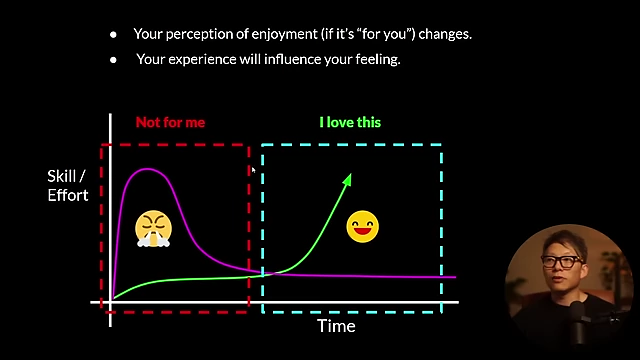
Incentivize Phase 2: Phase 2 is self-rewarding. Extending Phase 1 (hard, incompetent) reduces motivation. It's difficult to "play" in Phase 1 due to high effort and low skill.
Phase 1 is characterized by high effort and incompetence, while Phase 2 brings enjoyment and competence as the skill develops
[
00:29:59
]
Perception of Enjoyment Changes: Your feeling about a skill can change drastically. A skill perceived as "not for me" in Phase 1 (hard, high effort) can become "I love this" in Phase 2 (fun, low effort).
Perception of enjoyment for a skill can drastically change from 'not for me' in Phase 1 to 'I love this' in Phase 2
[
00:32:09
]
Goal: Reach Competence: A goal can be to push through Phase 1 to reach a baseline competence, just to assess if the skill "has legs" for a long-term pursuit.
Negative Impression: Quitting too early (in Phase 1) can leave a negative impression on your relationship with the activity, preventing future exploration.
Consciousness: Be aware of which phase you are in before deciding to quit. Examples like surfing (quitting early) versus snowboarding, bowling, or breakdancing (persisting to enjoyment).
Emotional Tolerance: It's extremely uncomfortable to persist through Phase 1, going against the brain's wiring. Creating evidence of successfully passing this point is vital.
Effective Exposure: Immersion means focusing on one thing, eliminating expensive switching costs.
Effective immersion reduces initial effort by focusing on one task and eliminating switching costs
[
00:38:19
]
Brain Normalization: The brain normalizes the activity, making it feel like "part of life now."
Unconscious Processing ("Bogoff"): When immersed, the brain continues to process information even when not actively practicing (e.g., sleeping), leading to breakthroughs.
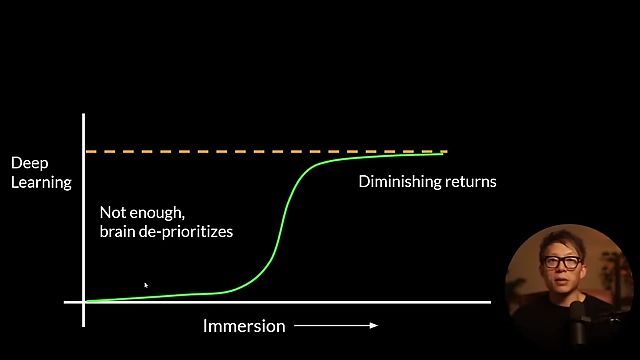
Rapid Increase in Familiarity: Increased immersion leads to a rapid increase in familiarity and orientation.
Deep Learning Curve: Insufficient immersion leads to the brain de-prioritizing the activity, hindering deep learning. There's an "ignition point" where immersion becomes effective, but also diminishing returns at very high immersion.
Deep learning requires sufficient immersion, avoiding both too little (brain de-prioritizes) and too much (diminishing returns)
[
00:41:09
]
Optimal Immersion: Balance between accelerated learning and sustainability in life. Too little, and the brain de-prioritizes; too much, and it's inconvenient, unsustainable, and leads to burnout.
Optimal immersion balances accelerated learning with sustainability, finding a 'sweet spot' that doesn't compromise other life habits
[
00:44:29
]
The goal is to operate in the "sweet spot" where learning is maximized without compromising other life aspects.
Key Points for Immersion: Increase exposure to activate brain prioritization (for most, as much as possible initially). Balance with practicality (do what you can sustain).
Return on Focus: Learning is not proportional to focus.
Low Grade Focus: Inefficient, low attention leads to very low learning (e.g., trying to learn while multitasking). A basic task takes all day.
High Grade Focus (In the Zone / Flow): Very efficient, high attention leads to exponential learning. One hour can equal four hours of work in a low-grade state.
High-grade focus (flow state) leads to exponential learning, making practice significantly more efficient than low-grade focus
[
00:45:49
]
Creating Space for High-Grade Focus: Multiple projects make it harder to achieve high-grade focus due to shorter time blocks and less dedicated resources (e.g., not affording workshops/coaching).
Environment Matters: Identify environments that foster high-grade focus (library, classes, workshops, coaching sessions). Coaching, in particular, can rapidly shift individuals into this state.
Goal: Increase learning per unit of effort, making the process faster and more enjoyable by compressing the initial effort curve.
Eliminating Easy Errors: Much of the initial effort lump consists of mistakes, program navigation, and dead ends. Quickly removing these "basic errors" accelerates the process.
Eliminating basic errors, program navigation issues, and dead ends significantly reduces the initial effort 'lump'
[
00:50:29
]
Biggest Problem: Repeating errors without realizing it.
Rule of Thumb: Follow step-by-step guides (YouTube, courses), direct training, or coaching to identify and avoid common mistakes.
Intuition is the Enemy for Beginners: Intuition is often wrong when learning new skills.
Example: Bowling: Brain optimizes for power, not consistency/accuracy, leading to incorrect technique.
Example: Snowboarding/Dancing: Brain optimizes for instinctive feel over proper technique, creating bad habits that need to be "undone."
Dead ends consume huge amounts of time and energy (e.g., 98% of mouse paths in a maze are wrong). External guidance drastically reduces wasted effort.
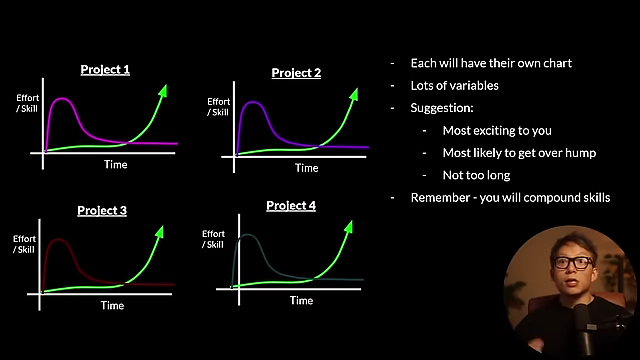
Each project has its unique effort and skill curves.
Suggestions for Prioritization:
Most Exciting: Increases motivation.
Most Likely to Get Over the Hump: Avoids early discouragement from very difficult projects.
Not Too Long: Shorter projects allow for faster skill compounding; the learned skills and experience can be applied to subsequent projects.
When stacking projects, prioritize those most exciting, most likely to overcome the initial hump, and not too long, allowing for skill compounding
[
00:56:48
]
Dual Learn: Maintain a primary project (main focus) and a secondary project (smaller, less intense).
If overwhelmed, cut the secondary project first, always protecting the primary.
Secondary projects can provide mental breaks from the primary.
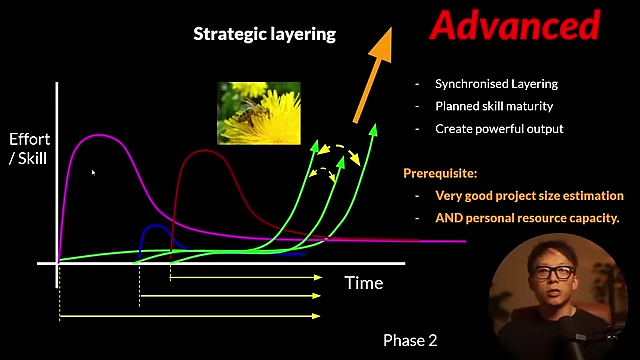
Prerequisite: A clear understanding of project sizing and personal resource capacity. Overestimating capacity or underestimating a project's size can derail both.
Synchronized Layering: Planned skill maturity where different skills are developed to "bloom" at the same time, creating powerful, synergistic output (e.g., developing presentation skills, video skills, and sales training simultaneously).
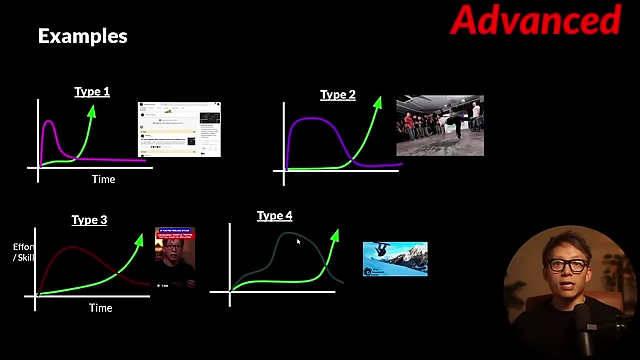
Each new skill or project has a unique "fingerprint" (effort/skill curve).
Common Types:
Type 1: Intense but short-lived pain/discomfort, quick reward. Suits those who tolerate intensity.
Type 2: High and long-duration pain/discomfort, flat/zero reward for a long time. Suits those who tolerate delayed gratification. Often leads to insane returns because competition drops off.
Type 3: Gradual effort and skill increase. Coaching can accelerate.
Type 4: Initial burst, then flatlining with high effort and no visible progress, then a later surge with external help.
Different skills have unique 'fingerprint' learning curves (Type 1-4), requiring varied emotional tolerance and strategies
[
01:05:18
]
Emotional Tolerance: Understand your emotional tolerance for different types of pain and reward structures. Beginners might start with Type 1 to build confidence before attempting Type 2.
More experience helps recognize these types, better estimate effort, and build appropriate tools/strategies.
Examples illustrate different learning curve types, such as community building (Type 1), breakdancing (Type 2), content creation (Type 3), and snowboarding (Type 4)
[
01:08:01
]
When Is the Skill Good Enough? (Skill Assessment) [1:11:05]
Define Your Goal: What do you want from this skill (fun, money, social connections)?
If pursuing multiple skills, compromise is necessary on how "good" you need to be at each.
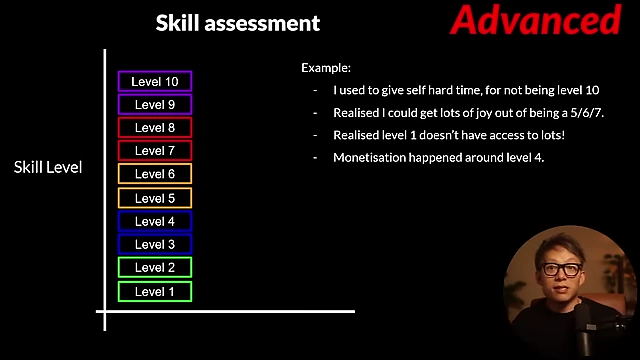
Skill Level (1-10 Scale):
Level 1-2: Often seen as a "tourist" by serious practitioners; limited access to opportunities.
Level 3-7: Unlocks more fun, collaboration, competition, and monetization (often starts around Level 4).
Level 8-10: Mastery level, high monetization potential, unique position.
A skill assessment scale (Level 1-10) helps define desired competence for fun, monetization, or social connections, especially when juggling multiple skills
[
01:14:58
]
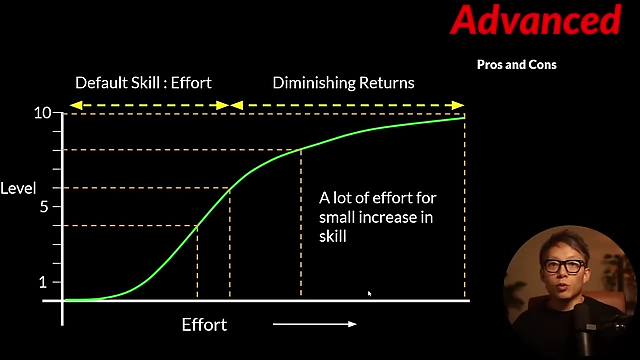
Diminishing Returns on Effort: As skill level increases (especially beyond Level 6-7), a lot more effort is required for small increases in skill.
Beyond a certain point (e.g., Level 6-7), effort yields diminishing returns for small increases in skill, making deep mastery less efficient for multi-skill development
[
01:18:58
]
Pros of High Level: More unique, less competition, high demand.
Cons of High Level: Extremely high effort, potentially not worth it if the goal is broad skill acquisition rather than deep mastery.
Optimal Level: The speaker aims for around 70% up the curve, where enjoyment, play, and practical benefits are maximized without incurring excessive effort for diminishing returns.
Consult experts to map out the time and effort required to reach desired skill levels before committing.