Lead exposure, primarily from leaded gasoline and paint, significantly affected the cognitive abilities, mental health, and crime rates of nearly half the US population, particularly Gen X.
Pioneering research by Herbert Needleman in the 1970s used children's baby teeth to link early lead exposure to behavioral and cognitive issues in childhood.
The phase-out of leaded gasoline, initiated by the Clean Air Act of 1970, correlated with a subsequent drop in violent crime rates in the 1990s, with studies demonstrating a direct link between the reduction of childhood lead exposure and the decrease in crime.
The Dunedin Study in New Zealand, a comprehensive longitudinal cohort study, revealed that high childhood lead exposure led to measurable IQ loss, altered personalities (e.g., increased neuroticism, decreased agreeableness), and downward social mobility in adulthood. These effects were observed across all socioeconomic strata in New Zealand due to universal leaded gasoline use.
Analysis applied to the US population estimated that 170 million Americans, especially Gen X, were exposed to lead levels that would now be considered unsafe and trigger medical intervention. This exposure resulted in an estimated loss of over 800 million IQ points and an increase in ADHD symptoms, anxiety, and depression across affected generations.
Despite significant reductions, lead remains a threat from old infrastructure (pipes, paint) and current industrial uses, highlighting ongoing environmental injustices and the need for robust regulation against the backdrop of industry efforts to obscure scientific findings on toxic chemicals.
A bar chart representing different age cohorts in the US population, colored according to their estimated historical lead exposure levels, with red indicating the highest exposure for Gen X.
[
00:16:38
]
Personal Investigation: The video's host, Adam, sent his baby teeth for analysis to determine his childhood lead exposure.
Teeth as a Time Machine: Baby teeth store a permanent record of early toxicant exposure, making them a unique tool for historical health analysis.
The Pervasive Danger of Lead: Even minute amounts of lead can profoundly damage the mind, body, and personality.
Scale of the Problem: Recent studies indicate that approximately half the US population (around 170 million people) was exposed to harmful levels of lead.
Video's Goal: To explore how lead quietly altered the minds of generations and reshaped the course of American history and health.
Kids with high lead levels in their teeth showed increased distractibility, reduced persistence, and difficulty following sequential directions.
A bar chart illustrates how children with higher lead exposure (indicated by warmer colors) exhibit increased rates of behavioral problems such as distractibility, persistence issues, and inability to follow directions.
[
00:02:50
]
Subsequent direct testing on the children confirmed that those with higher lead exposure scored worse on intelligence, focus, and reaction time tests.
Demographic Consistency: The study was conducted in demographically homogenous communities, which helped mitigate concerns about racial bias in teacher ratings.
The Source of the Poison and Industry Obfuscation [05:00]
Historical Awareness and Modern Indifference [05:12]
The dangers of lead were known since antiquity.
Despite this, in the early 20th century, lead was widely used in plumbing and paint in America.
The National Lead Company even published coloring books promoting lead as healthy.
An old advertisement for "Lead helps to guard your health" from the National Lead Company, promoting lead.
[
00:05:25
]
An advertisement for "The Dutch Boy's Lead Party" coloring book from the National Lead Company, promoting lead to children.
[
00:05:29
]
Dr. Alice Hamilton, a leading expert on lead poisoning, confronted GM's head scientist, Charles Kettering, in 1925, warning of worker deaths and public health risks from leaded exhaust.
These warnings were largely ignored due to the booming automotive industry and the significant profits to be made.
For four decades, the Kettering Laboratory, funded by General Motors and Ethyl Corporation, produced the majority of research on lead exposure.
Their studies primarily focused on acute lead poisoning, allowing them to assert that the science on chronic exposure and long-term harms was "unresolved," thereby reassuring the government and public that environmental lead was "probably fine."
Lead is particularly harmful in trace amounts because its ability to mimic calcium disrupts vital calcium signaling throughout the nervous system.
Infants are especially vulnerable due to their rapidly developing brains and their tendency to put objects in their mouths, leading to higher exposure.
An infographic illustrating the human nervous system with a magnified section showing how lead (small dots) disrupts calcium signaling (larger circles) at neural synapses.
[
00:07:30
]
Needleman's wider studies revealed that lead exposure disproportionately affected lower-income and minority communities.
Poor neighborhoods were more likely to have older houses with lead paint and be located near major roads, increasing exposure risk.
A graphic showing blood lead levels in different groups: 7% for privileged white children, 25% for poor white children, and 55% for poor black children.
[
00:07:56
]
A map of Los Angeles indicating areas with higher lead soil concentration in blue.
[
00:08:14
]
The Phasing Out of Lead and its Impact on Crime [08:30]
Economist Jessica Wolpaw Reyes investigated a compelling theory linking the reduction in childhood lead exposure to the mysterious drop in violent crime rates in the 1990s.
Prior research showed that higher lead exposure correlated with increased high school dropout rates, juvenile delinquency, and arrests for violent crimes.
When the national lead exposure curve was shifted forward by 22 years (the approximate age when childhood lead-exposed individuals would become adults and potentially commit crimes), it showed a strong alignment with the crime rate curve.
A graph showing the correlation between national lead exposure levels (red line) and violent crime rates (white line), with lead exposure shifted forward by 22 years to demonstrate the delayed impact.
[
00:10:28
]
A website demonstrating that strong visual correlations do not necessarily imply causation cautions against drawing conclusions from overlapping lines alone.
A graph demonstrating a spurious correlation between annual US household spending on alcoholic beverages and the number of septic tank servicers and sewer pipe cleaners in New Hampshire.
[
00:10:46
]
A graph demonstrating a spurious correlation between the popularity of the first name Jordan and robberies in South Carolina.
[
00:10:54
]
To overcome the issue of "spurious correlations," Reyes conducted a state-by-state analysis.
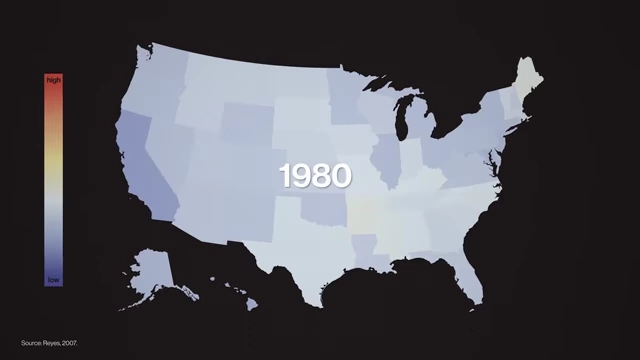
Her research found that states with larger decreases in lead exposure consistently experienced larger drops in violent crime.
A heatmap of the US showing varying levels of lead reduction across states in 1980, used for state-by-state analysis.
[
00:11:44
]
Text from Jessica Wolpaw Reyes's study highlighting that states with larger lead decreases experienced larger crime decreases.
[
00:11:53
]
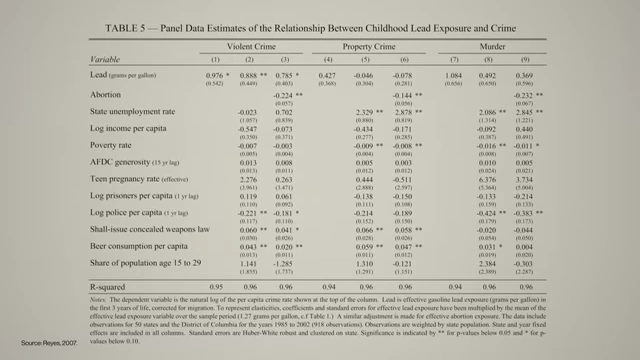
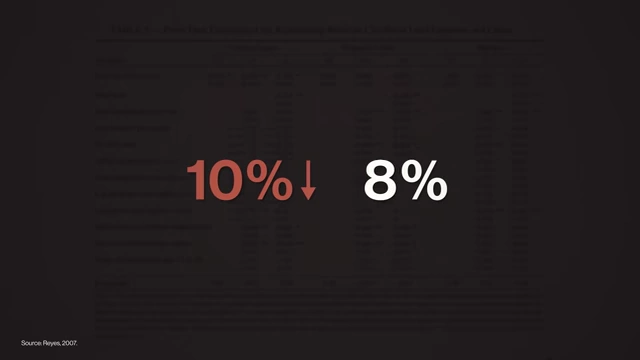
She calculated that for every 10% reduction in childhood lead exposure, there was an approximately 8% drop in violent crime.
A table showing statistical data, likely from Jessica Wolpaw Reyes's study, detailing the relationship between childhood lead exposure and crime.
[
00:12:09
]
An overlay of "10% ↓ 8%" on a statistical table, representing an 8% drop in violent crime for every 10% reduction in childhood lead exposure.
[
00:12:13
]
Similar lead-crime connections were observed in other countries like Canada, Australia, and Italy.
Graphs showing the correlation between lead exposure (red line) and violent crime (white line) in Canada, Australia, and Britain.
[
00:12:39
]
While many factors influence crime, lead is recognized as a significant contributor to the 1990s crime drop, with estimates ranging from 7-28% of the fall in homicide attributed to lead.
Text from a meta-analysis suggesting that lead pollution may be responsible for 7-28% of the fall in homicide in the US.
[
00:12:50
]
Long-Term Cognitive and Mental Health Effects (The Dunedin Study) [13:01]
Studying the lifelong effects of lead is difficult due to challenges in tracking individuals over many decades, often resulting in skewed data from participant attrition.
To overcome these challenges, researchers turned to the Dunedin Study, an unparalleled longitudinal study in New Zealand.
An aerial map showing the country of New Zealand.
[
00:13:52
]
Initiated in 1972-73, it tracked 1,037 babies born in Dunedin, with a remarkably high retention rate (mid-90%) throughout their lives.
Crucially, New Zealand had some of the world's highest levels of lead in its gasoline, and lead exposure in the cohort was not socially patterned, affecting children from all socioeconomic backgrounds. This allowed researchers to study the effects of lead independently of social factors.
Lifelong Cognitive and Personality Impacts [15:05]
IQ Loss: Participants with the highest early lead exposure experienced a greater decline in IQ points as they aged from childhood to 38.
A graph with error bars showing the change in IQ from childhood to age 38, categorized by levels of lead exposure, illustrating a more significant decline in IQ points for those with higher exposure.
[
00:15:46
]
Altered Personalities: High lead exposure was linked to altered personality traits, including decreased agreeableness and increased neuroticism. Individuals struggled more with emotional regulation, future planning, and organization.
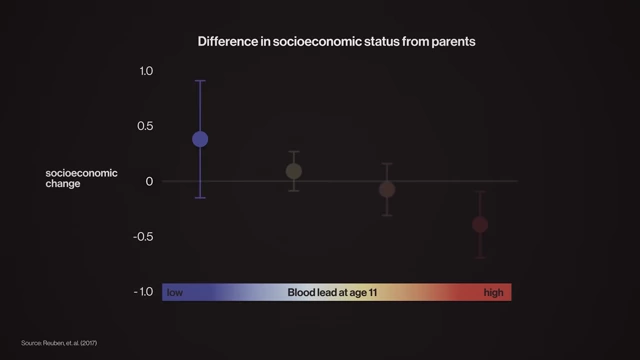
Social Mobility: These effects impacted social mobility, with highly exposed individuals experiencing downward social mobility compared to their parents, while those with low exposure tended to fare better than their parents.
A graph illustrating the difference in socioeconomic status from parents based on childhood lead exposure, with higher exposure correlating to downward social mobility.
[
00:16:05
]
Aaron Reuben used the findings from the Dunedin Study and US lead exposure data to calculate the impact on the entire American population.
His analysis showed that nearly half the country (170 million people), particularly the Gen X cohort, were exposed to lead levels that would today necessitate medical intervention and case management.
A bar chart representing different age cohorts in the US population, colored according to their estimated historical lead exposure levels. Red indicates the highest exposure.
[
00:16:38
]
Manish Arora, a "tooth detective," analyzed Adam's baby tooth using laser ablation mass spectrometry.
Barium levels in the tooth indicated the timing of breastfeeding.
A heatmap of barium concentration in a baby tooth cross-section, showing a surge (red/yellow) marking the onset of breastfeeding.
[
00:17:30
]
Adam's tooth showed very low lead levels (blue-green areas), indicating he was born after the peak of the lead crisis and likely benefited from having an older sibling who would have absorbed more of the mother's stored lead during pregnancy.
A heatmap of lead concentration in Adam's baby tooth cross-section, showing very low levels (blue/green), indicating low exposure.
[
00:17:43
]
An illustration of a human skeleton, indicating that lead is stored in the mother's bones before being passed to the fetus.
[
00:17:59
]
A side-by-side comparison of Adam's baby tooth (left) showing low lead concentration and a modern child's tooth (right) showing even lower lead levels.
[
00:18:31
]
In stark contrast, a tooth from someone born in a high-risk area like East Harlem showed significant prenatal and postnatal lead exposure.
A cross-section of a baby tooth showing high lead concentration (red and green colors) indicating significant prenatal and postnatal lead exposure.
[
00:18:49
]
The US population born between 1951 and 1980 is estimated to have collectively lost over 800 million IQ points due to lead exposure.
Text from a research paper indicating a total loss of over 824 million IQ points for the US population due to lead exposure.
[
00:18:59
]
Lead significantly shifted the distribution of mental health symptoms, including ADHD, anxiety, and depression, for these generations.
A heatmap-like graph illustrating how lead exposure shifted the distribution of ADHD symptoms across different generations, with warmer colors indicating higher symptom prevalence.
[
00:19:19
]
It is estimated that at least 150 million cases of mental illness could be attributed to lead exposure.
As these affected cohorts age, more health issues, such as cardiovascular problems, kidney/liver damage, and potentially higher rates of dementia, are anticipated.
Lead is Not a Past Problem / Ongoing Challenges [19:47]
Despite progress, we still live in a "leaded world." Lead is continuously mined and used in various products (e.g., batteries), which can still leach into water, soil, food, and human bodies.
A world map highlighting in red countries where lead is still actively mined.
[
00:20:01
]
A close-up of used batteries, many marked with the "Pb" symbol for lead, piled outdoors.
[
00:20:05
]
Old infrastructure, such as lead pipes (as seen in Flint, Michigan) and lead paint in old buildings (like Milwaukee schools), continues to pose risks.
Recent Policy Failures and Industry Influence [20:27]
In 2018, Milwaukee faced a lead paint crisis in schools, but the CDC's Childhood Lead Prevention Program team was effectively disbanded, leaving communities without crucial support.
A letter discussing lead poisoning in Milwaukee schools, mentioning the CDC's Childhood Lead Prevention Program.
[
00:20:37
]
A document showing the text "due to the complete loss of our Lead Program, we will be unable to provide assistance." This reflects the firing of the CDC's Childhood Lead Prevention Program team.
[
00:20:39
]
This incident mirrors historical patterns where industry influence can obstruct environmental protections. For instance, Dow Chemical's donations to political campaigns coincided with the EPA's refusal to ban a pesticide harming babies' brains, citing "unresolved science" – a tactic reminiscent of the lead industry's past actions.
Text from a research paper about "Prenatal naled and deficits in infant mothers."
[
00:21:37
]
Call for Vigilance: The video concludes by emphasizing that industry will not self-regulate and advocates for strong environmental policies to prevent future "horrific" long-term consequences from toxic chemicals.