Understanding Christian Productivity: Five Foundational Pillars for a Biblical Worldview
This video outlines five foundational pillars for Christian productivity, contrasting them with secular self-help ideologies.
- You Belong to God: Productivity stems from stewardship, not self-ownership.
- You Are Empowered by God: True productivity comes from abiding in Christ and His Spirit, not self-reliance.
- You Exist to Glorify God: The ultimate purpose of all work is to make much of God, not for personal success or happiness.
- You Were Saved to Work for God: Salvation empowers believers to perform good works that are a necessary consequence of faith.
- You Will Stand Before God: This accountability motivates Christians to pursue eternal rewards through their work, rather than transient earthly gains.
These pillars provide a theological framework upon which practical productivity strategies can be built, ensuring a God-centered approach.
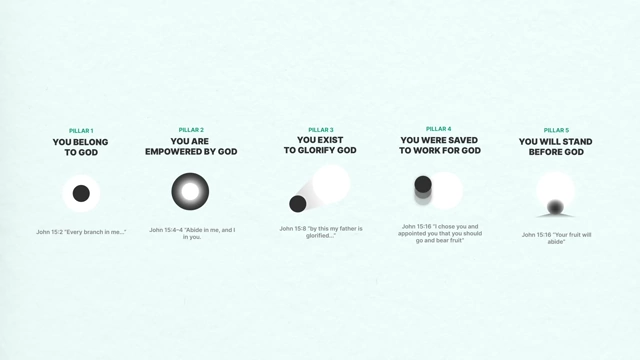
The Five Pillars of Christian Productivity [ 00:22:29 ]
The Self-Help Lie [00:00]
The video begins by addressing the "self-help lie" prevalent in secular productivity, which asserts that individuals belong to themselves and their efforts are primarily for personal happiness. This stands in contrast to a Christian worldview.
Five Pillars of Christian Productivity [00:29]
The speaker introduces five foundational truths that form a biblical philosophy of personal productivity, serving as the scriptural bedrock for all practical strategies like goal setting and habit formation.

Pillar 1: You Belong to God [01:06]
This pillar emphasizes that Christians are not their own, but were "bought with a price" (1 Corinthians 6:19-20), making productivity an obligation, not an option.
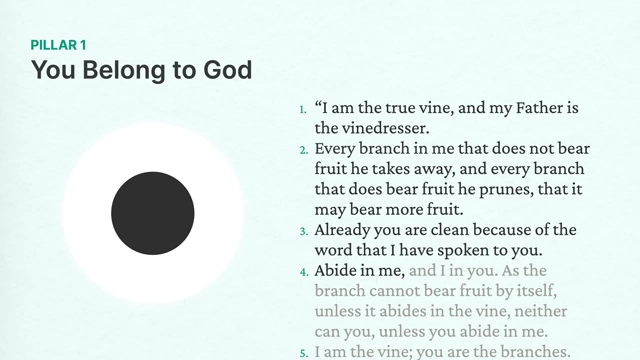
- Biblical Basis:
- Jesus' teaching in John 15 refers to Him as the true vine and believers as branches, implying a connection and purpose beyond oneself.
- Paul's statement in 1 Corinthians 6:19-20, "You are not your own, for you were bought with a price," directly challenges the notion of self-ownership.

Pillar 1: You Belong to God with 1 Corinthians 6:19B-20 scripture reference [ 00:01:43 ]
- Implications for Productivity:
- Productivity for a Christian is not optional; it is a serious calling to serve God well and manage the life, talents, and opportunities He has given.
- This understanding forms "the ORIGIN of our productivity," guiding the desire to be productive out of love and belonging to God.
The first pillar is the origin of our productivity [ 00:03:30 ]
- Contrast with Worldly Productivity:
- The world says, "You belong to yourself," and productivity is about personal gain.
- The Bible states, "Your life is a stewardship," and Christian productivity asks how to make a good return for Christ, our master.
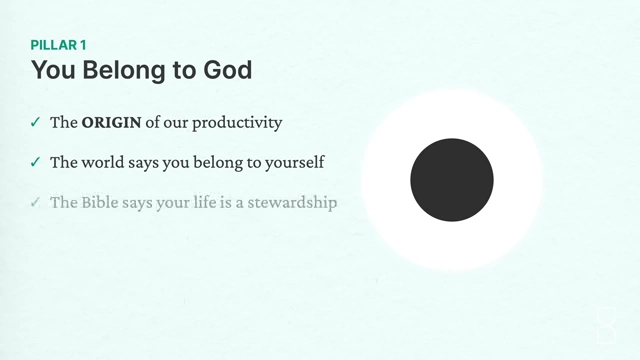
Comparison of worldly and biblical views on productivity's origin [ 00:04:05 ]
Pillar 2: Empowered by God [04:19]
This pillar highlights that the power for Christian productivity comes not from within oneself, but from God, through union with Christ and the indwelling Holy Spirit.
- Biblical Basis:
- John 15:4-5 stresses abiding in Christ, stating, "As the branch cannot bear fruit by itself, unless it abides in the vine, neither can you, unless you abide in me. ...for apart from me you can do nothing."
- Philippians 2:13 confirms, "for it is God who works in you, both to will and to work for his good pleasure."

Pillar 2: You Are Empowered by God with Philippians 2:13 scripture reference [ 00:06:18 ]
- Source of Productivity:
- Biblical productivity is conceived not like a factory producing goods, but like a fruit tree bearing fruit, emphasizing natural growth from divine connection.

Biblical productivity compared to a factory [ 00:05:45 ] - This is "the SOURCE of our productivity," recognizing God as the ultimate power source, transforming us from the inside out.
The second pillar is the source of our productivity [ 00:06:29 ]
- Biblical productivity is conceived not like a factory producing goods, but like a fruit tree bearing fruit, emphasizing natural growth from divine connection.
- Consequences and Contrast:
- When fruit is produced through God's power, God receives the glory, not the individual.
- Worldly productivity encourages self-reliance, self-discipline, or external motivators.
- Christian productivity relies on God's power working through us.
Comparison of worldly and biblical views on productivity's source [ 00:07:38 ]
Pillar 3: Glorify God [07:44]
The ultimate purpose of a Christian's life and productivity is to glorify God, making His greatness known.
- Biblical Basis:
- John 15:8 states, "By this my Father is glorified, that you bear much fruit and so prove to be my disciples."
- 1 Corinthians 10:31 commands, "So, whether you eat or drink, or whatever you do, do all to the glory of God."

Pillar 3: You Exist to Glorify God with 1 Corinthians 10:31 scripture reference [ 00:11:46 ]
- Defining Glory and Glorifying God:
- God's glory is the manifestation of who He is, His attributes and greatness.
- To glorify God means to "make much of Him," not by adding to His objective glory, but by giving Him "ascribed glory."
- This is done through:
- Worship: Praising Him for who He is and what He has done.
- Attitudes: Thinking His thoughts, loving His law, showing Him affection.
- Actions: Being productive and a good steward in His power, with attitudes that reflect Him as His image-bearer.
- Purpose of Productivity:
- This is "the PURPOSE of our productivity," fulfilling our primary reason for existence.

The third pillar is the purpose of our productivity [ 00:12:18 ]
- This is "the PURPOSE of our productivity," fulfilling our primary reason for existence.
- Contrast with Worldly Productivity:
- The world says be productive for success, happiness, or comfort (self-focused).
- The Bible says to glorify God in all that you do, imaging Him correctly through work and attitude.
Comparison of worldly and biblical views on productivity's purpose [ 00:12:18 ]
Pillar 4: Saved to Work for God [12:38]
This pillar asserts that Christians are saved not just from sin, but unto a purpose: to perform good works for God.
- Biblical Basis:
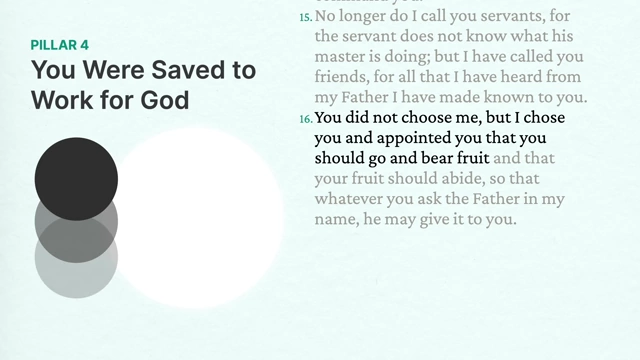
- John 15:16 declares, "You did not choose me, but I chose you and appointed you that you should go and bear fruit..."
- Titus 2:14 states that Jesus "gave himself for us to redeem us from all lawlessness and to purify for himself a people for his own possession who are zealous for good works."
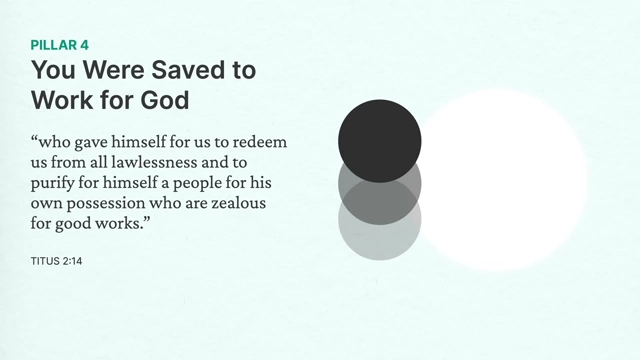
Pillar 4: You Were Saved to Work for God with Titus 2:14 scripture reference [ 00:13:24 ] - Ephesians 2:8-10 teaches that while salvation is by grace through faith, believers are "created in Christ Jesus for good works, which God prepared beforehand, that we should walk in them."
- The Content of Productivity:
- Good works are a necessary consequence of salvation, enabling believers to serve and glorify God as redeemed creatures.
- This understanding fosters a "mission mindset," clarifying the purpose in life beyond simply avoiding sin or waiting for heaven.
- This is "the CONTENT of our productivity," referring to the good works and fruit we are called to bear.

The fourth pillar is the content of our productivity [ 00:15:54 ]
- Practical Application:
- Daily discipline in areas like spiritual growth (Bible reading, prayer), physical well-being, fulfilling responsibilities, and maintaining a God-glorifying attitude.
- Contrast with Worldly Productivity:
- The world promotes productivity for following personal dreams or self-fulfillment.
- The Bible calls for productivity in following Christ, bearing good fruit, and engaging in good works.
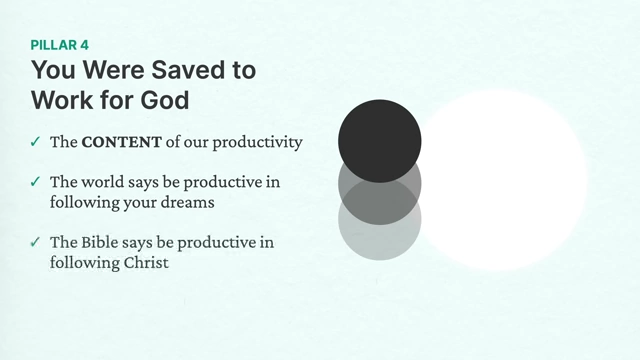
Comparison of worldly and biblical views on productivity's content [ 00:17:14 ]
Pillar 5: Accountable to God [17:23]
This final pillar provides the motivation for Christian productivity, stemming from the understanding that all believers will stand before God and give an account, leading to eternal reward.
- Biblical Basis:
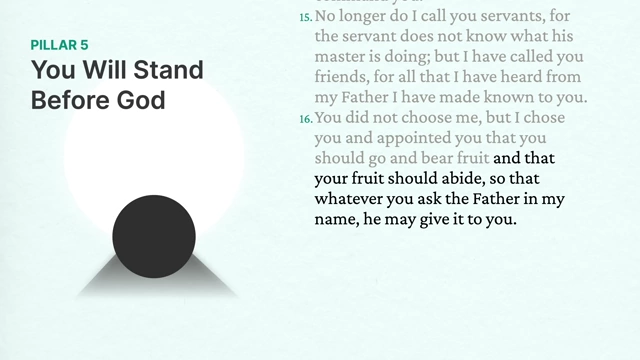
- John 15:16 implies that fruit should "abide," meaning good works done in Christ's power are preserved into eternity.
- Romans 14:12 confirms, "So then each of us will give an account of himself to God."

Pillar 5: You Will Stand Before God with Romans 14:12 scripture reference [ 00:19:32 ] - 1 Corinthians speaks of building on the foundation of Christ with "gold, jewels or precious things" that endure judgment, as opposed to "wood, hay or stubble" that are burned up.
- Matthew 6:19-20 instructs, "Do not lay up for yourselves treasures on earth... but lay up for yourselves treasure in heaven..."

Pillar 5: You Will Stand Before God with Matthew 6:19-20 scripture reference [ 00:20:22 ]
- Motivation for Productivity:
- This is "the MOTIVATION for our productivity," not out of fear of losing salvation, but in anticipation of eternal reward for faithful stewardship.
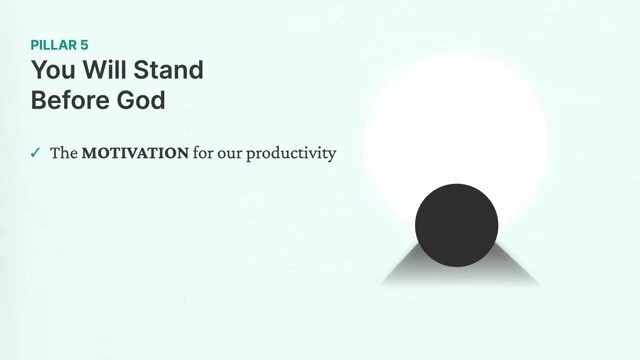
The fifth pillar is the motivation for our productivity [ 00:21:20 ] - It encourages a long-term, eternal perspective on life and work, seeking to invest in what lasts beyond this earthly existence.
- This is "the MOTIVATION for our productivity," not out of fear of losing salvation, but in anticipation of eternal reward for faithful stewardship.
- Contrast with Worldly Productivity:
- The world advocates productivity to "get more of this life" (money, experiences) because it sees life as finite.
- The Bible encourages productivity to "gain more of the next life," focusing on eternal treasures.
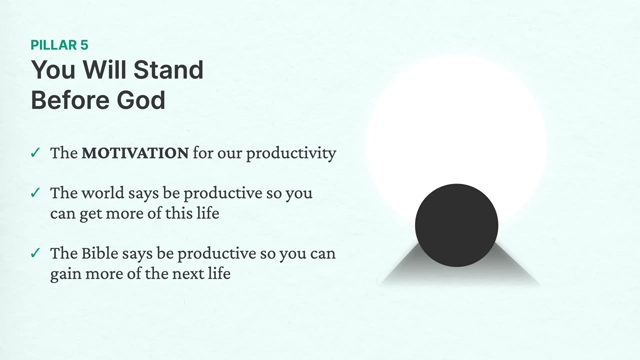
Comparison of worldly and biblical views on productivity's motivation [ 00:22:17 ]
Conclusion [22:22]
The five pillars—You belong to God, You are empowered by God, You exist to glorify God, You were saved to work for God, and You will stand before God—form the indispensable foundation for Christian productivity. Any tactical advice, whether on goal setting, habit formation, or task management, must be built upon this robust biblical worldview to prevent it from becoming self-focused and ultimately lacking eternal significance.