Trump's Response to BRICS' De-dollarization Efforts and the Global Shift Towards Gold
This video discusses the BRICS alliance's efforts to challenge the US dollar's global dominance, President Trump's reaction, and the broader trend of de-dollarization, emphasizing the shift towards gold as a reserve asset.
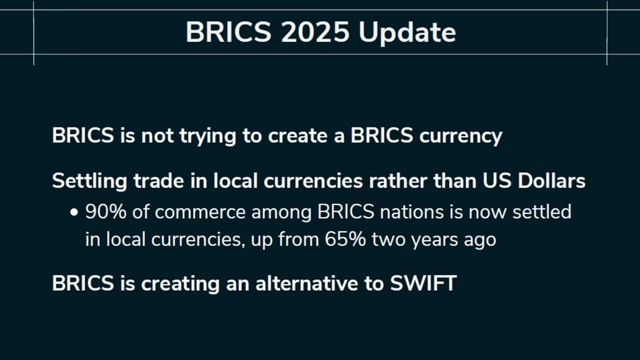
BRICS' Challenge to US Global Dominance [0:00]
BRICS, an alliance of countries, aims to challenge the United States' international dominance in trade and finance.
- The recent BRICS annual meeting in Brazil (July 6-7) concluded with a 31-page statement from leaders. [0:13]
Trump's Reaction: Tariff Threat and Dollar's Importance [0:51]
President Trump reacted strongly to the BRICS developments, issuing a threat via social media.
- Trump stated that any country aligning with BRICS' "anti-American policies" would face an additional 10% tariff without exception. [0:59]
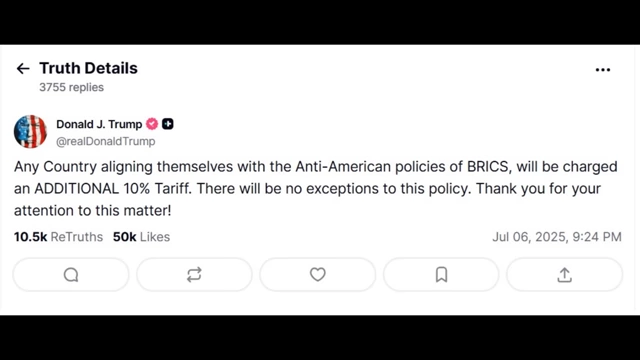
Donald Trump's social media post threatening a 10% tariff on countries aligning with BRICS' "anti-American policies." [ 00:01:00 ] - He explicitly stated that BRICS was established to "hurt us" and "degenerate our dollar." [1:31]
- Trump emphasized that losing the US dollar's status as the world standard would be akin to "losing a major world war" and would fundamentally change the United States. [2:53]
- He asserted that the dollar is "king" and vows to maintain its dominant position. [3:07]
The US Dollar's Current Status and Vulnerabilities [2:15]
Despite its current dominance, the US dollar is showing signs of weakening.
- The dollar is experiencing its "worst year in the past 50 years" due to devaluation. [2:24]
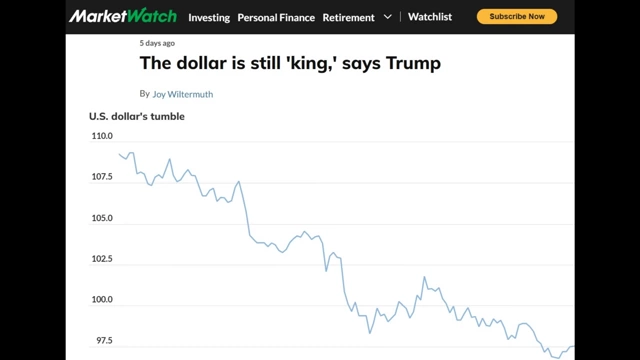
A graph illustrating the tumble of the U.S. dollar's value over time. [ 00:02:20 ] - If the US dollar were dethroned as the world's reserve asset, it would be devastating for Americans, leading to accelerated inflation and significantly higher interest rates. [2:33]
BRICS' De-dollarization Strategies [3:12]
BRICS nations are implementing key strategies to reduce reliance on the US dollar.
- Settling trade in local currencies: BRICS is not trying to create a new BRICS currency but is focusing on bilateral trade using their own national currencies. [3:32]
- Approximately 90% of commerce among BRICS nations is now settled in local currencies, a significant increase from 65% just two years prior. [3:46]
- Creating alternatives to SWIFT: BRICS is developing new international payment systems to bypass the current SWIFT system, which is dominated by Europe and the US. [3:58]
- BRICS Pay: A payment system specifically for BRICS countries. [4:07]
- mBridge: An international payment system not limited to BRICS countries, which has reached "minimum viable product" (MVP) status. [4:12]
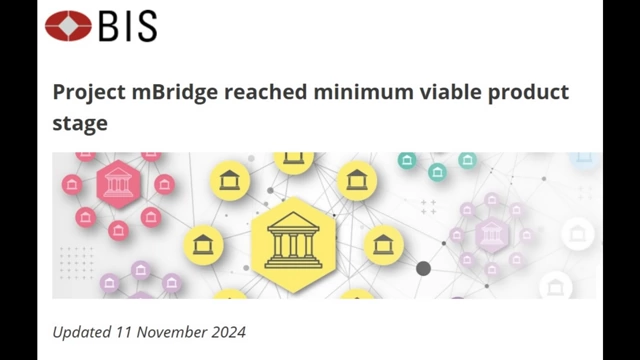
An article announcing Project mBridge has reached minimum viable product status. [ 00:04:55 ] - In 2024, the UAE successfully sent 50 million dirhams to China via mBridge in 10 seconds, demonstrating its operational capability. [5:02]
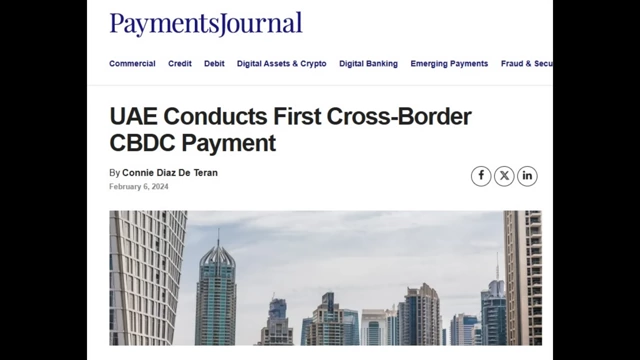
An article reporting the UAE's first cross-border CBDC payment conducted via mBridge. [ 00:05:17 ] - As of July 2025, the MVP phase is complete, with pilot transactions ongoing and new participants being accepted for the commercial readiness phase. [5:17]
- These alternatives aim to prevent countries from being "locked out" of the global banking system, as happened to Russia in 2022. [4:18]
- In 2024, the UAE successfully sent 50 million dirhams to China via mBridge in 10 seconds, demonstrating its operational capability. [5:02]
The Global Shift Towards Gold as a Reserve Asset [5:32]
The primary concern for the United States is the potential loss of the dollar's status as the world's reserve asset, leading countries to hold wealth in gold instead.
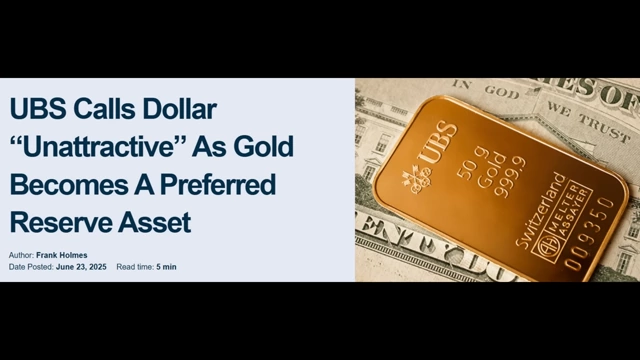
- Central banks worldwide are decreasing their holdings of US Treasury securities. [6:24]
- US Treasury securities held by foreign central banks are at the same level as 13 years ago, not adjusted for inflation, indicating a relative decline in real terms. [6:38]
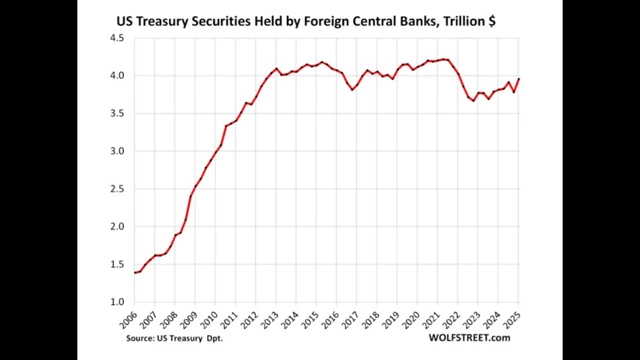
A graph showing U.S. Treasury Securities held by Foreign Central Banks in trillions of dollars, illustrating a plateau after 2013. [ 00:06:25 ] - This trend means higher interest rates for the US, burdening consumers and the US government, which holds $37 trillion in debt. [6:52]
- If foreign countries do not buy US government IOUs, the Federal Reserve will have to print trillions of dollars to buy them, further devaluing the dollar. [7:14]
- US Treasury securities held by foreign central banks are at the same level as 13 years ago, not adjusted for inflation, indicating a relative decline in real terms. [6:38]
- Increased Gold Purchases by Central Banks: Instead of US bonds, central banks have been net buyers of gold for 15 consecutive years, with purchases significantly ramping up in the past three years. [7:27]
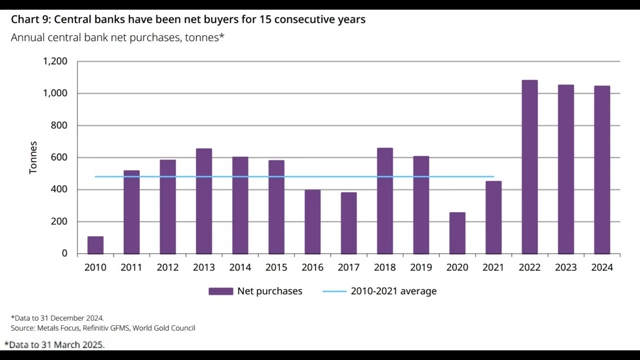
A bar chart illustrating annual central bank net purchases of gold in tonnes, showing a significant increase from 2022 onwards. [ 00:07:30 ] - This shift is partly driven by global financial reforms. [7:43]
Impact of Basel III on Gold's Role [7:59]
The Basel III reforms, implemented by the Bank of International Settlements (BIS) effective July 1, 2025, are reinstating physical gold's importance in the international financial system.
- Basel III rules make physical gold a "Tier 1 asset," meaning banks holding physical gold can lend out a higher percentage (e.g., $90 for every $100 of physical gold). [7:59]
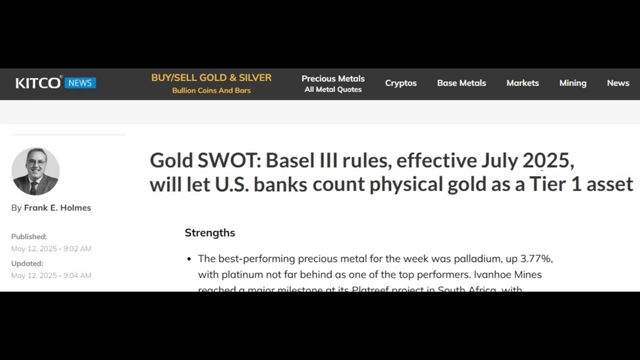
An article detailing how Basel III rules classify physical gold as a Tier 1 asset for U.S. banks. [ 00:08:10 ] - In contrast, "paper gold" (e.g., contracts) has higher funding requirements, limiting lending capacity (e.g., $15 for every $100 of paper gold). [8:23]
- This regulatory change incentivizes banks to favor physical gold, driving increased demand for its physical delivery. [8:42]
China's Strategic Expansion in the Gold Market [9:15]
Gold is central to the BRICS plan to challenge the US dollar, and China is actively expanding its influence in the global gold market.
- While major international gold markets are COMEX (New York) and LBMA (London), China's Shanghai Gold Exchange (SGE) has been limited due to currency controls. [9:01]
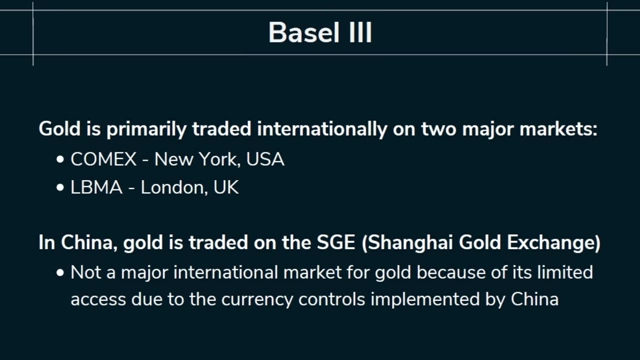
A slide outlining the major international gold markets: COMEX, LBMA, and SGE. [ 00:09:10 ] - China is now expanding its gold market internationally, beginning with Hong Kong. [9:28]
- Hong Kong, as a special administrative region, offers an international jurisdiction for trade and finance despite being politically part of China. [9:35]
- The SGE has opened its first offshore physical gold delivery vaults in Hong Kong to increase international participation. [9:50]
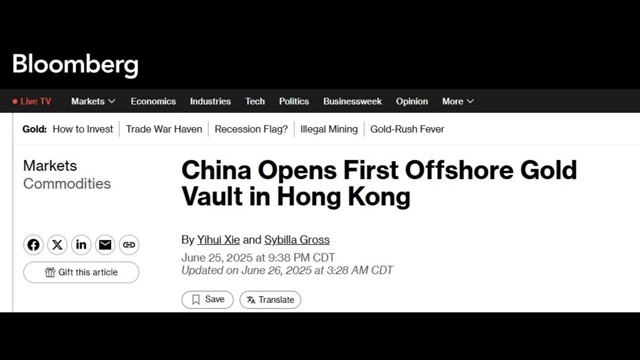
An article announcing China has opened its first offshore gold vault in Hong Kong. [ 00:09:50 ] - This is seen as a strategic first step, with China planning to open gold vaults globally (e.g., Dubai, Singapore, across Asia, Africa, and the Middle East) as part of the BRICS Pay settlement pilots. [10:02]
- This broader trend suggests a global move towards a gold standard where gold, not US dollars or government debt, becomes the world's primary reserve asset. [10:17]
Conclusion: The De-dollarization Process [10:28]
The process of de-dollarization is not solely driven by BRICS but is being accelerated by their actions.
- President Trump's tariff threats are an attempt to slow this process, but it remains uncertain if this will succeed or inadvertently accelerate de-dollarization. [10:28]
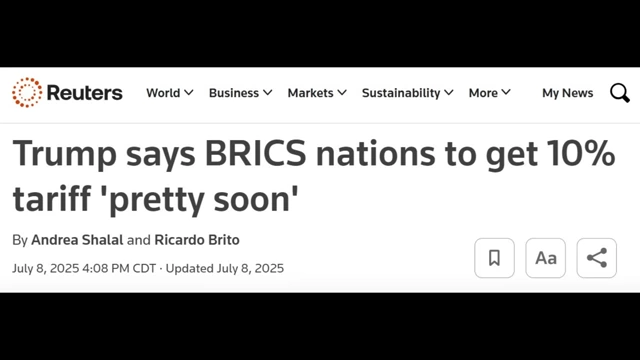
A Reuters article reporting Trump's statement on upcoming BRICS tariffs. [ 00:10:51 ] - De-dollarization is a continuous process, not a singular event. [10:54]
- Gold is anticipated to be a significant component of the emerging new global monetary system. [11:03]