Equal Weight Index Funds: Understanding Their Risks, Costs, and Why Better Alternatives Exist
Summary:
This video discusses the perceived appeal and inherent problems of equal weight index funds compared to market capitalization (cap) weighted funds.
- Initial Appeal: Equal weight funds seem attractive due to lower concentration in top stocks and lower valuations, and have historically outperformed cap-weighted funds in certain periods.
- Key Problems: They introduce significant risks, costs, and inefficiencies.
- Higher Volatility: Equal weight funds exhibit greater price variability.
- Unintended Factor Exposure: They naturally tilt towards smaller and cheaper (value) stocks, which are theoretically riskier.
- Uncontrolled Sector Tilts: They create significant underweights in some sectors (e.g., technology) and overweights in others (e.g., industrials).
- High Turnover and Costs: Frequent rebalancing to maintain equal weights leads to much higher trading costs.
- Negative Momentum Strategy: Systematically selling winners and buying losers inherently works against the momentum factor.
- Better Alternatives: Funds from providers like Dimensional offer similar small-cap and value factor exposures more efficiently by limiting sector divergence, avoiding negative momentum trading, and managing turnover, without the drawbacks of naive equal weighting.

Comparison of S&P 500 Equal Weight and Market Cap Weighted ETFs performance since 2003, showing slight outperformance by equal weight. [ 00:01:20 ]
Introduction to Index Fund Weighting [0:00]
The video addresses a common question about equal weight index funds, explaining that while they seem compelling, they come with unique risks and inefficiencies. The speaker will outline why he does not use them.
Market Capitalization Weighting [1:43]
- Definition: Typical index funds assign weights based on each company's market capitalization (size).
- A larger company constitutes a larger portion of the index.
- Logic and Benefits:
- Represents the market's collective valuation of each stock's economic importance, considered a "passive" approach.
- Requires less frequent rebalancing, as the index naturally adjusts with stock price changes, resulting in lower turnover and trading costs.

Comparison of top 10 holdings in S&P 500 Equal Weight vs. Market Cap Weighted ETFs, showing significantly higher concentration in the latter. [ 00:01:59 ]
Equal Weighting [2:12]
- Definition: Assigns equal weight to all stocks in an index, regardless of their market capitalization.
- By design, an equal-weighted index will not be concentrated in a small number of stocks.
Perceived Issues with Market Cap Weighting [3:05]
- Concentration Concerns: Market cap weighting can lead to high concentration in a few top-performing stocks, as seen currently in the US market.
- This concentration naturally fluctuates over time.
- Historical Relationship with Returns: Despite concerns, historical data shows no strong relationship between market concentration and future market returns, both in the US and globally.
- Many other countries exhibit higher market concentration than the US.

Historical US stock market concentration in top stocks from 1927 to 2025, showing current high levels. [ 00:03:19 ] 
Scatter plot illustrating no strong correlation between market concentration and 10-year future US stock market returns. [ 00:03:38 ]
- Many other countries exhibit higher market concentration than the US.
Inherent Risks and Inefficiencies of Equal Weight Index Funds [4:00]
While equal weighting avoids concentration, it introduces other significant issues.
Higher Volatility [4:43]
- Equal weight indexes tend to have higher volatility (standard deviation of returns) compared to market cap weighted indexes, implying greater risk.
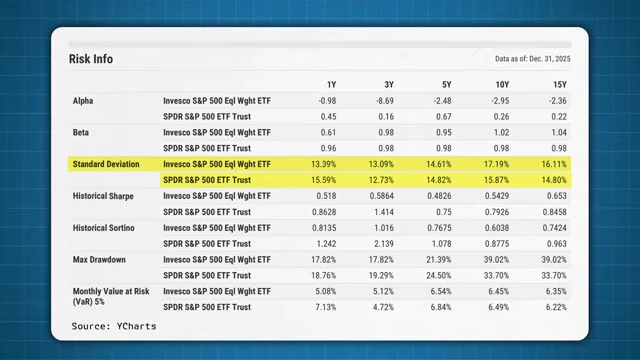
Risk information table showing higher standard deviation (volatility) for the S&P 500 Equal Weight ETF compared to the market cap weighted S&P 500 ETF. [ 00:04:48 ]
Unintended Factor Exposure (Small Cap and Value) [5:02]
- Equal weighting inherently overweights smaller and lower-priced (value) stocks and underweights larger, more expensive stocks.
- These factor exposures (small cap and value) are theoretically priced as riskier by the market.
- Equal weight funds show lower aggregate valuations (Price-to-Earnings, Price-to-Book ratios) due to this tilt, which is often seen as a benefit but can be achieved more efficiently.
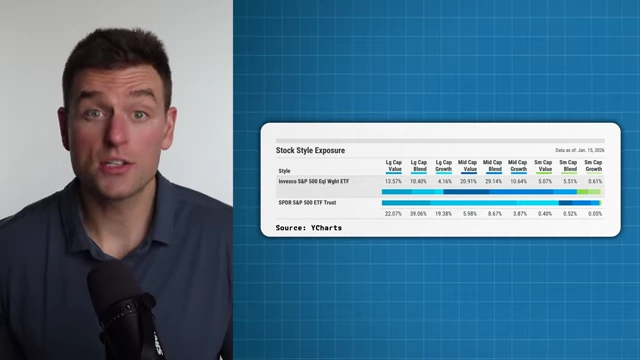
Stock style exposure comparison, highlighting equal weight funds' tilt towards small-cap and value stocks. [ 00:05:20 ] 
Fund characteristics for an S&P 500 Equal Weight ETF, showing lower Price-to-Earnings and Price-to-Book ratios. [ 00:05:57 ]
Uncontrolled Sector Tilts [6:18]
- Equal weight indexes result in materially different sector exposures compared to market cap weighted indexes.
- This introduces additional sector-specific risks that most investors may prefer to avoid (e.g., large underweight to technology, overweight to industrials in the S&P 500 equal weight ETF).

Comparison of stock sector exposures between S&P 500 Equal Weight and Market Cap Weighted ETFs, revealing significant differences. [ 00:06:27 ]
- This introduces additional sector-specific risks that most investors may prefer to avoid (e.g., large underweight to technology, overweight to industrials in the S&P 500 equal weight ETF).
Increased Rebalancing and Turnover Costs [6:54]
- To maintain equal weights, these funds must frequently rebalance by selling stocks that have grown larger and buying stocks that have shrunk.
- This leads to significantly higher portfolio turnover (e.g., 10 times higher than market cap weighted S&P 500 ETFs), incurring implicit and explicit trading costs borne by investors.
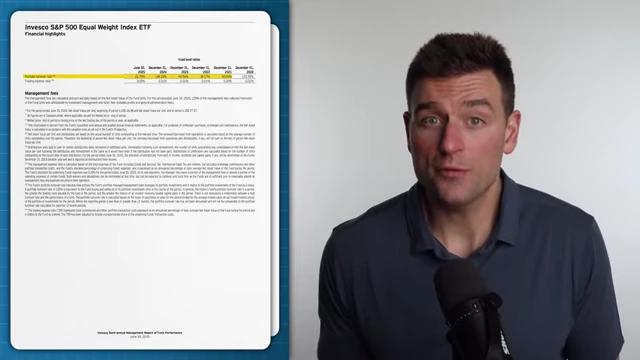
Table showing significantly higher annual turnover rates for the S&P 500 Equal Weight ETF compared to market cap weighted funds. [ 00:07:16 ]
Systematic Negative Momentum Strategy [7:31]
- Equal weighting is inherently a negative momentum strategy.
- Momentum: A well-documented phenomenon where recent winners tend to continue winning, and recent losers tend to continue losing.
- Equal Weighting's Action: By selling stocks that have recently performed well (winners) and buying stocks that have performed poorly (losers) to maintain equal weights, these funds systematically trade against momentum.

Illustration of equal weight rebalancing, showing winners (larger bars) being sold and losers (smaller bars) being bought to maintain equal weights. [ 00:07:56 ]
- Multi-factor regression analysis confirms that equal weight funds have statistically significant negative exposure to the momentum factor, alongside positive exposure to size and value factors.
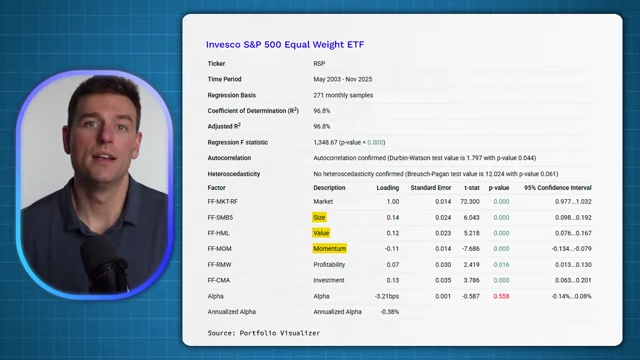
Multifactor regression results for an S&P 500 Equal Weight ETF, indicating positive exposure to size and value factors and negative exposure to momentum. [ 00:08:36 ]
More Efficient Alternatives for Factor Exposure [9:04]
Investors seeking exposure to smaller and lower-priced stocks can achieve this more efficiently without the drawbacks of equal weighting.
Intentional Factor Tilting (e.g., Dimensional Funds) [9:12]
- Funds like Dimensional's US Core Equity funds intentionally target specific types of stocks (e.g., smaller, lower-priced, more profitable companies).
- These funds maintain similar small-cap and value factor exposures but with a more deliberate and controlled approach.
Controlling for Sector Bets [10:17]
- Dimensional funds limit sector divergence from market weights by capping sector differences, thus avoiding unintended sector bets.

Stock sector exposure comparison showing how Dimensional's fund maintains a more balanced sector approach compared to the equal weight S&P 500 ETF. [ 00:10:15 ]
Optimizing Turnover and Momentum Exposure [10:28]
- Dimensional funds apply flexible trading rules to avoid selling recent winners and buying recent losers, thus managing momentum exposure more effectively.
- By starting with market cap weights and applying modest tilts, they minimize unnecessary deviations and aggressive rebalancing, leading to lower turnover.
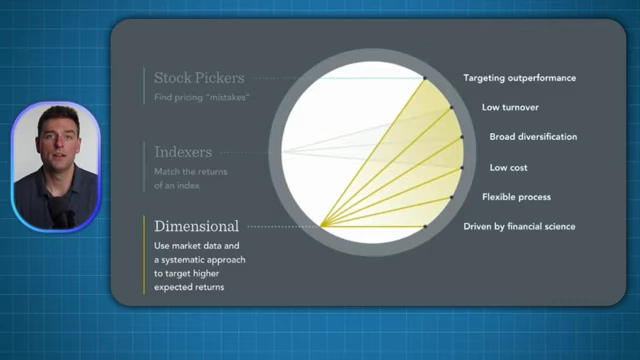
Infographic explaining Dimensional's systematic approach to targeting higher expected returns with low turnover and broad diversification. [ 00:10:44 ]
Performance Comparison of Intentional Funds [12:09]
- Comparing live fund data since 2005 (when Dimensional Core Equity One Fund launched), both the equal weight S&P 500 ETF and the Dimensional Fund trailed the market cap S&P 500 ETF (a period favoring large, high-priced stocks).
- However, the Dimensional Fund outperformed the equal weight fund during this period.

Performance comparison since 2005 showing Dimensional US Core Equity 1 outperforming the S&P 500 Equal Weight ETF, both trailing the S&P 500 ETF during this period. [ 00:12:23 ]
Historical Performance and Backtesting Caveats [12:47]
Backtested Performance (1971-present) [12:47]
- Backtested data for the S&P 500 equal weight index from 1971 shows strong outperformance compared to the market cap weighted S&P 500.
- This period was characterized by strong performance of small cap and value stocks.
- Multi-factor regression analysis confirms this performance is largely explained by higher small cap and value exposure, despite negative momentum contribution.

Backtested performance from 1971, showing significant outperformance of the S&P 500 Equal Weight Index over the S&P 500 Total Return Index. [ 00:12:53 ] 
Backtested factor regression results (1971-2025) for S&P 500 Equal Weight Index and DFA US Core Equity 1 Index, showing factor loadings. [ 00:13:13 ]
The Limitations of Backtest Data [13:38]
- Backtest data can be unreliable, often benefiting from hindsight and not reflecting real-world implementation costs or liquidity constraints.
Conclusion: Why Equal Weight Funds Fall Short [14:03]
- Equal weighting's appeal stems from concerns about market concentration and high valuations, along with attractive long-term backtests.
- However, its strong past returns are largely explained by its unintentional tilts towards smaller and cheaper stocks, not by any intrinsic "magic" of equal weighting itself.
- Key Drawbacks: Large over/underweights at stock and sector levels, high portfolio turnover, and a systematic bet against momentum.
- Recommendation: Investors seeking exposure to small and value factors can do so more efficiently through intentionally designed funds (like those from Dimensional) that control for these downsides, limiting turnover, managing sector exposure, and avoiding negative momentum trading.