California's Proposed Billionaire Tax: How Page 26 Allows Expansion to All Residents and Assets Without Further Voter Approval
This video warns Californians about the proposed "Billionaire Tax," arguing it's a deceptive measure that could ultimately impact all residents by expanding the tax to include homes, 401ks, and savings. The tax bill, particularly a clause on page 26, grants the legislature power to lower wealth thresholds and make the tax annual without further voter approval. The bill also establishes four mechanisms for the Franchise Tax Board to access financial records, appraise assets, and levy significant penalties. The speaker argues that the Service Employees International Union (SEIU) is pushing this bill to address a multi-trillion dollar pension deficit, and the wealthy are already leaving California, shifting the tax burden to the middle class, similar to historical tax precedents like the 1913 federal income tax.
Precedent and Deception: The AB 130 Flashback [0:00]
The speaker highlights a pattern of legislative deception in California, referencing AB 130.
- Previous Deception with AB 130:
- Governor Newsom publicly stated he would "never sign a mileage tax," yet it was already signed into law on page 137, section 58, of AB 130.
- This bill added $324,000 to the cost of every new home in California, impacting housing affordability.
- The speaker asserts that similar deceptive tactics are being employed with the current "billionaire tax."

Graphic highlighting a $324,000 cost added to homes due to AB 130. [ 00:00:50 ]
The Proposed Billionaire Tax [1:45]
The video describes the publicized version of the California wealth tax.
- Key Features of the "Billionaire Tax":
- Proposed by the Service Employees International Union (SEIU) as a ballot initiative.
- A one-time 5% tax on net assets over $1 billion, including private stock and real estate.
- Marketed as affecting only about 200 billionaires with a combined wealth of $2 trillion.
- Presented as a simple and fair solution with "nothing to do with you or me," which the speaker calls "bait."
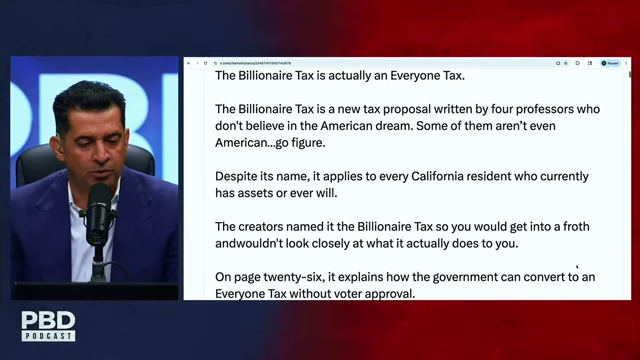
Page 26: The Legislative Trap Door [3:00]
The core argument revolves around a critical clause buried within the bill.
- Section 50310 on Page 26:
- States that "The Legislature may amend the 2026 Billionaire Tax Act, by statute passed in each house of the Legislature by roll call vote entered into the journal, two-thirds of the membership concurring if the statute is consistent with and furthers the purposes of the 2026 Billionaire Tax Act."
- This grants the legislature the power to:
- Expand the tax to include more people.
- Lower the wealth threshold from $1 billion (e.g., to $1 million or $500,000).
- Convert it from a one-time tax to an annual or permanent tax.
- All without requiring another ballot measure or voter approval.
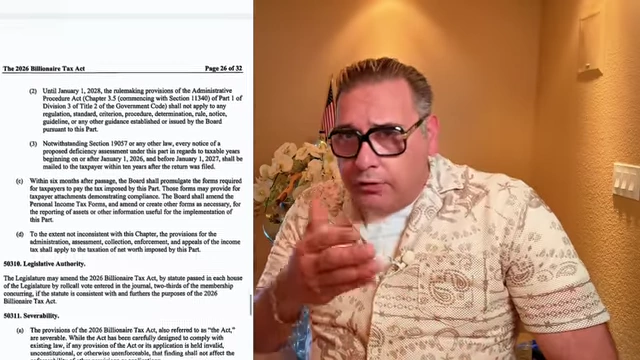
Screenshot of the bill text on Page 26 detailing the legislative authority to amend the tax. [ 00:02:45 ]
The Four Mechanisms: Accessing Your Records [5:30]
The video details how an expanded wealth tax would function and impact individuals.
- How the "Everyone Tax" Would Work:
- The proposed "Billionaire Tax" is framed as an "Everyone Tax" by its creators to avoid close scrutiny of its true implications.
- This tax can be adjusted to become a yearly tax without voter approval.
- Asset Listing: Residents would be required to list all assets and their values to the California Franchise Tax Board (FTB).
- Government Appraisal: The FTB would be authorized to appraise assets and confirm their reported values.
- 40% Penalty: A 40% penalty could be imposed if the FTB determines a reported asset value was "too low" in their opinion.
- Financial Record Subpoena: The FTB would be allowed to subpoena financial records from every one of a resident's financial institutions for auditing.
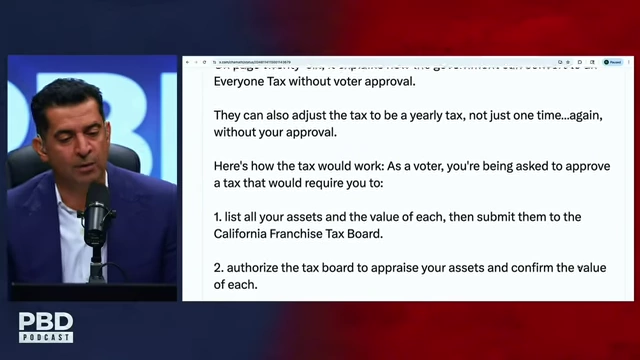
The four mechanisms of the proposed "Everyone Tax" that would require asset listing, government appraisal, penalties, and financial record subpoenas. [ 00:05:25 ]
- Implications for Middle-Class Families:
- The speaker provides an example of a family with a combined income of $180,000, owning a house, a 401k, a small investment account, and a rental property.
- If the threshold drops to $1-2 million, such a family would be subjected to asset listing, government appraisal, financial record scrutiny, and potential 40% penalties on unrealized gains or disputed valuations.
The Real Villain: SEIU Pension Hole [8:00]
The speaker asserts the true motivation behind the bill.
- Hidden Agenda: The bill is not primarily about healthcare or taxing billionaires, but about filling a massive pension deficit.
- SEIU's Role: The Service Employees International Union (SEIU) filed the ballot initiative due to "massively ballooning pension benefits" and significant increases in pension programs, leading to a multi-trillion dollar unaccounted-for pension liability in California.
- Shifting the Burden: The goal is to use this tax to address this pension hole, with the cost ultimately falling on ordinary citizens under the guise of taxing billionaires.
The Billionaires Are Already Gone [9:30]
The video discusses the inevitable outcome of wealth taxes on the wealthy.
- Wealth Exodus: When wealth taxes are implemented, billionaires tend to leave the state or country, leading to a collapse of the tax base.
- France's experience is cited, where a similar tax led to a 40% loss of revenue due to wealth flight.
- Mentions $700 billion in wealth has already fled California since the tax was announced, with prominent figures like Larry Page, Sergey Brin, and Travis Kalanick having left.

A podcast speaker discussing the exodus of wealth from France due to similar tax policies. [ 00:09:53 ]
- Impact on the State: The pension hole remains, and other public services like medical care are still underfunded, forcing Sacramento to find money from other sources (i.e., the middle class via Page 26).
1913: Same Trick, Different Century [11:00]
A historical parallel is drawn to illustrate the long-term danger of such taxes.
- Federal Income Tax Precedent: The 1913 federal income tax started as a 1% tax, only on the wealthy, and was initially promised as a one-time measure.
- Historical Pattern: This tax eventually expanded to become a permanent, widespread tax affecting every American, demonstrating how taxes initially targeting the rich can broaden to include the general population.

The speaker making a point while drawing a historical parallel to the 1913 federal income tax. [ 00:11:39 ]
You Pay The Bill [12:30]
The conclusion emphasizes who will ultimately bear the financial burden.
- The Burden on Remaining Residents: Those who stay in California – homeowners, savers, and hard-working individuals who built wealth within the state – will pay the bill.
- Lack of Protection: These individuals typically lack the "offshore trusts and Wyoming LLCs and teams of lawyers" that billionaires use to avoid such taxes.
- Call to Action: The speaker urges viewers to read the fine print (Page 26, AB 130) and share the information with others, to prevent them from being swayed by the "free money" narrative.