Traditional SSL/TLS relied on manual workflows, static RSA keys, and multi-year validity, presenting severe security vulnerabilities and operational overhead.
State-sponsored surveillance and catastrophic bugs like Heartbleed exposed structural flaws in CAs and static key exchanges, forcing the industry to adopt Perfect Forward Secrecy (PFS).
Google's Certificate Transparency (CT) mandate bypassed traditional CA audits by requiring a public, append-only ledger of all issued certificates, eventually causing the collapse of untrustworthy CAs like Symantec.
Let's Encrypt and the ACME protocol shifted the security landscape toward free, fully automated, short-lived domain-validated certificates.
Browser vendors are unilaterally driving certificate lifetimes down from years to a planned 47-day limit by 2029, making end-to-end automation mandatory for modern web architecture.
Future-proofing infrastructure requires automated certificate lifecycle management to seamlessly handle frequent renewals and prepare for upcoming post-quantum cryptography standards.
The timeline of security vulnerabilities, protocol deprecations, and algorithm retirements over 20 years of TLS/SSL history
[
00:41:00
]
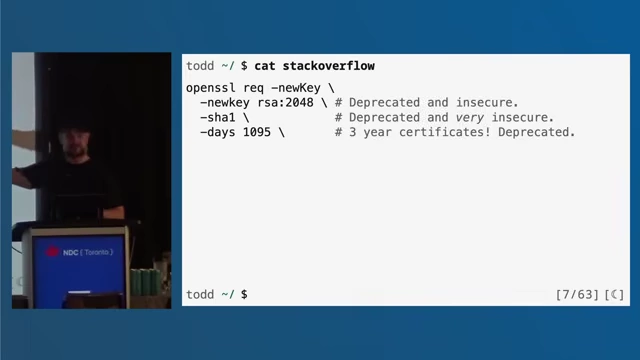
Securing a website historically required manually generating a Certificate Signing Request (CSR) using complex, copy-pasted OpenSSL commands.
Legacy commands copied from sites like StackOverflow frequently specified 2048-bit RSA keys, SHA-1 signatures, and long validation periods of three years or more.
RSA keys historically performed a dual role in the handshake, acting both to verify the server's identity and to encrypt the pre-master secret.
Legacy StackOverflow OpenSSL commands advocating deprecated configurations like SHA-1 and multi-year lifetimes
[
00:02:30
]
The security of the web relied on a rigid, hierarchical chain of trust.
Browsers shipped pre-bundled with Root Certificate Authorities (CAs) that were implicitly trusted.
Root CAs signed intermediate CAs, which in turn signed leaf certificates for individual domains.
The standard TLS chain of trust, linking a Root CA to an Intermediate CA and ultimately to the leaf domain certificate
[
00:05:50
]
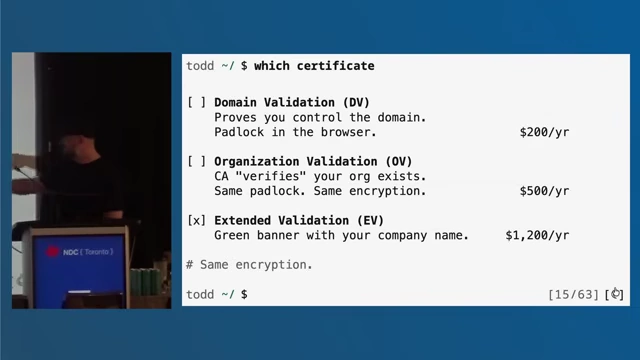
Traditional CAs operated as a high-margin protection racket, charging arbitrary fees for different tiers of validation.
Domain Validation (DV): Verified basic domain ownership via automated email links, costing around $200/year.
Organization Validation (OV): Involved human-verified organizational lookups, costing around $500/year.
Extended Validation (EV): Required intensive legal and corporate paperwork to display a "green bar" in browser URL fields, costing up to $1,200/year.
The three traditional tiers of certificate validation and their steep annual pricing models prior to automation
[
00:08:20
]
The Structural Vulnerabilities That Broke the Ecosystem [00:11:51]
The CA/Browser Forum's self-regulatory model failed to enforce proper security compliance.
CAs paid their own auditors to comply with WebTrust standards, creating misaligned incentives that allowed negligent operations to go unpunished.
Several major security breaches demonstrated that CAs could not be blindly trusted.
In 2011, the Dutch CA DigiNotar was completely compromised by hackers who accessed their root certificate, issuing rogue certificates for google.com to intercept Iranian user traffic.
Other CAs like Comodo and TurkTrust suffered similar breaches, undermining the absolute trust historically placed in root certificates.
The 2013 Edward Snowden leaks revealed that intelligence agencies leveraged structural design flaws to perform mass surveillance.
Programs like PRISM and TEMPORA recorded encrypted internet traffic en masse.
Because traditional TLS handshakes used static RSA key exchanges, agencies could retroactively decrypt years of recorded historical traffic if they subsequently stole or legally compelled the server's private key.
The 2014 Heartbleed vulnerability accelerated the transition away from long-lived certificates.
A buffer overflow bug in OpenSSL allowed attackers to read 64KB of server memory, exposing active private keys across 17% of secure servers globally and requiring the mass revocation of hundreds of thousands of active certificates.
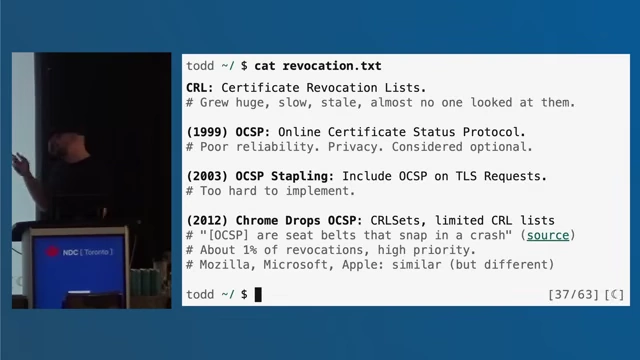
Traditional certificate revocation mechanisms were fundamentally broken and failed to scale.
Certificate Revocation Lists (CRLs) grew too large, slow, and stale to be useful.
The Online Certificate Status Protocol (OCSP) suffered from poor reliability and privacy concerns, leading browser vendors like Google Chrome to drop support in favor of limited, custom lists (CRLSets).
The history and limitations of different certificate revocation methods (CRL, OCSP, OCSP Stapling, CRLSets)
[
00:30:37
]
The industry adopted Perfect Forward Secrecy (PFS) to prevent retroactive decryption of intercepted data.
PFS splits the roles of identity verification and data encryption.
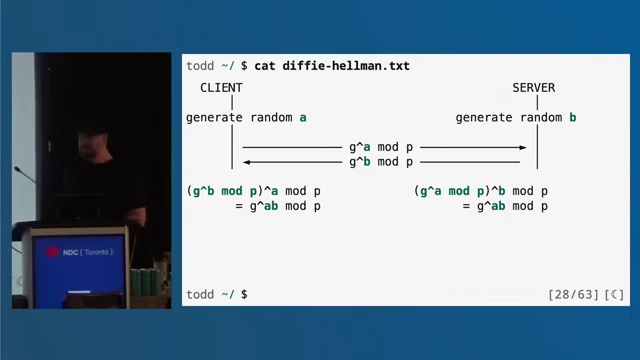
While the certificate's private key still proves identity, data encryption relies on unique, ephemeral (one-time) session keys generated per connection.
These keys are negotiated dynamically on both ends of the connection using Diffie-Hellman mathematical exchanges, ensuring that a leaked private key cannot decrypt past traffic.
The mathematical negotiation of ephemeral keys via Diffie-Hellman key exchange, enabling Perfect Forward Secrecy
[
00:19:20
]
Obsolete cryptographic algorithms were systematically retired.
SHA-1 hashes, deemed insecure by researchers in 2005, were officially deprecated after Google demonstrated practical collision attacks ("SHAttered") in 2017.
Static RSA key exchanges were banned under TLS 1.3, which discarded legacy cipher suites to enforce PFS as a mandatory protocol requirement.
Certificate Transparency and the Fall of Traditional CAs [00:20:23]
Google bypassed the CA/Browser Forum's stagnation by mandating Certificate Transparency (CT) in 2015.
Under CT, CAs are required to publish every issued certificate to a public, append-only cryptographic ledger.
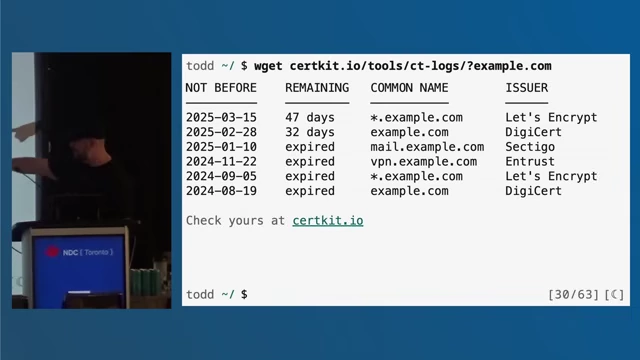
Domain owners can audit these logs to instantly detect any unauthorized certificates issued for their domains.
An example of a Certificate Transparency log lookup tool, allowing public enumeration of every certificate issued for a domain
[
00:22:40
]
Browser vendors used root program control to strictly enforce security compliance.
In 2017, CT logs caught Symantec misissuing over 30,000 certificates without authorization (including for google.com).
Google unilaterally distrusted all Symantec-owned roots (including VeriSign, Thawte, and GeoTrust), breaking their certificates in Chrome and forcing Symantec to sell its failing CA business to DigiCert.
Extended Validation certificates lost all practical utility.
Google and Apple removed EV "green bar" indicators from browser interfaces after user studies proved they provided zero measurable protection against phishing, rendering the premium pricing of EV certificates obsolete.
The Rise of ACME, Let's Encrypt, and Short-Lived Certificates [00:33:01]
Mozilla, the EFF, and other partners established the Internet Security Research Group (ISRG) to launch Let's Encrypt in 2015.
Let's Encrypt offered free, 90-day certificates to incentivize automated renewal workflows and eliminate the manual "runbook" model of certificate management.
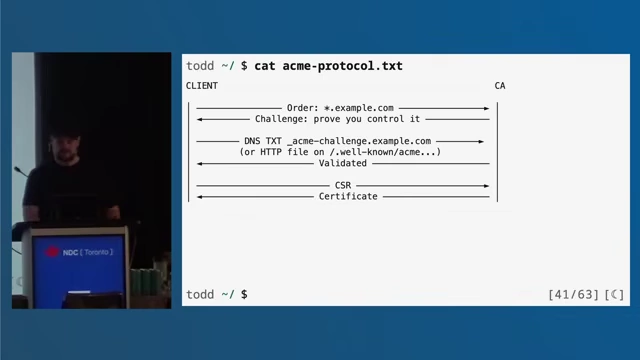
The Automated Certificate Management Environment (ACME) protocol standardized end-to-end automation.
Rather than relying on human verification, ACME-compatible clients automatically request certificates by solving validation challenges.
CAs verify domain control automatically by querying a unique DNS text record or checking a temporary cryptographic file served via HTTP.
The machine-to-machine validation flow of the automated ACME protocol
[
00:35:10
]
Automation successfully scaled security across the web, with Let's Encrypt growing to issue over 60% of all publicly trusted certificates.
Despite automated issuance, manual distribution and deployment steps remain a primary source of service outages.
In 2025, Epic Games suffered a major outage due to a failed manual deployment of an otherwise successfully renewed certificate, illustrating the danger of incomplete automation.
The Future: Shorter Lifetimes and Post-Quantum Security [00:44:33]
Browser vendors are steadily forcing certificate lifetimes down to mitigate the threat of compromised, unrevocable keys.
Following Apple's unilateral enforcement of a 398-day limit in 2020, browser vendors established a roadmap to aggressively reduce valid lifetimes to 200 days in 2026, 100 days in 2027, and 47 days by 2029.
The timeline for the reduction of certificate lifetimes down to 47 days by 2029
[
00:45:40
]
Shrinking lifetimes from 398 days to 47 days increases an organization's manual renewal frequency tenfold, rendering manual deployment models entirely unfeasible.
The impending arrival of quantum computing requires another fundamental overhaul of cryptographic infrastructure.
Practical quantum computers are expected to easily break the Diffie-Hellman and RSA mathematical problems that underpin modern key exchanges.
Although NIST has finalized Post-Quantum Cryptography (PQC) standards, organizations must migrate to automated certificate lifecycle managers now to handle the complex, heavy-duty key rotations required for quantum-resistant algorithms.