Resolving Distributed Systems Failures: Refactoring Tightly Coupled Checkout Flows with Sagas and the Outbox Pattern
Summary:
- Jimmy Bogard breaks down a common six-line checkout implementation that tightly couples database transactions with external API calls (Stripe, SendGrid, RabbitMQ).
- Synchoronously executing remote calls within a database transaction boundary creates severe reliability vulnerabilities, leading to inconsistent states such as customers being charged without orders being created.
- He reviews four classical patterns for handling service-to-service failures: Ignore, Retry (with Idempotency), Undo (Compensating Transactions), and Coordinate (Two-Phase Commit).
- Tight temporal and process coupling is identified as the root cause of these distributed system failures.
- To resolve this, Bogard refactors the checkout flow into an asynchronous, resilient architecture using the Outbox Pattern to decouple message publishing.
- He integrates a Process Manager (Saga Pattern) to coordinate payments and notifications, utilizing Stripe's two-step authorize-and-capture flow to isolate failures.
The Six Little Lines of Fail [01:23]
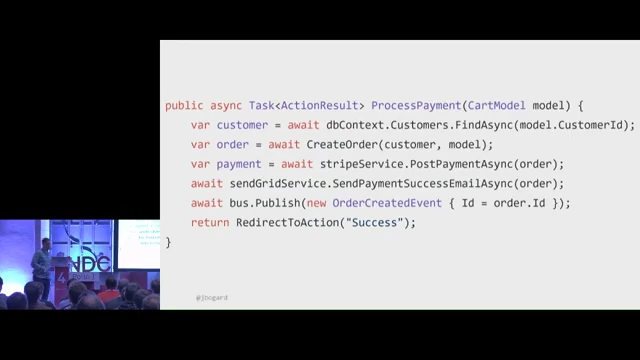
- Seemingly Simple Implementation: Jimmy Bogard reviews a common checkout process implementation containing six sequential operations.
- Find the customer from the database.
- Create the order in memory.
- Process payment via Stripe (external HTTP API).
- Send a thank-you email via SendGrid (external HTTP API).
- Publish an
OrderCreatedmessage to RabbitMQ. - Redirect the user to a success page.
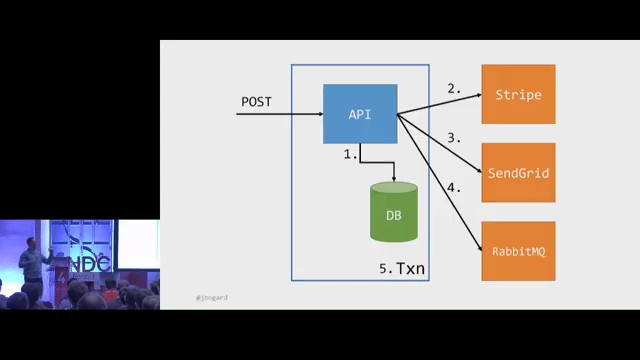
- This whole sequence runs within an implicit database transaction.
Analysis of Failure Modes [11:10]
- Tightly Coupled Architecture: All external dependencies are chained synchronously inside the database transaction boundary.
- Scenario 1: Stripe Call Fails [11:40]
- If the call to Stripe fails with an exception, the database transaction rolls back.
- The customer is shown an error, and the database remains consistent because no order is created.
- Scenario 2: SendGrid Call Fails [12:35]
- If SendGrid throws an exception, the database transaction rolls back, meaning the order is not saved.
- However, Stripe has already successfully captured the payment.
- The customer is charged, but no order exists in the database.
- Scenario 3: RabbitMQ Call Fails [13:35]
- If publishing to RabbitMQ fails, the transaction rolls back, and Stripe payment has already been captured.
- Additionally, SendGrid has already sent a "Thank You" email to the customer.
- This leaves the customer charged and emailed, but with no order created in the system.
- Scenario 4: DB Transaction Commit Fails [14:15]
- If all API calls succeed but the database transaction commit fails (e.g., due to a constraint or DB timeout), the transaction rolls back.
- The customer is charged, sent an email, downstream systems are notified via RabbitMQ, but no record of the order exists in the primary database.
Four Options for Addressing Failures [14:30]
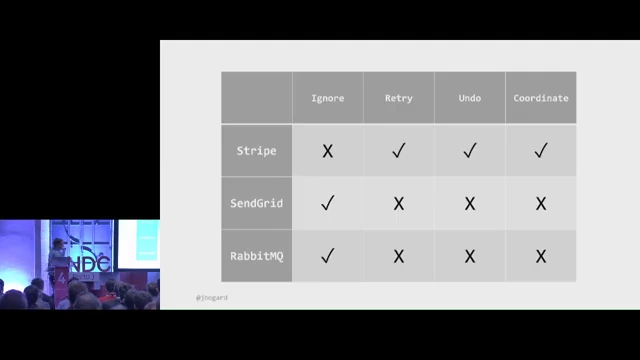
- Jimmy Bogard presents four classical patterns (described by Gregor Hohpe) for managing failure between distributed resources.
- Option 1: Ignore [14:49]
- Swallowing the exception and continuing with execution.
- Applicability: Useful for non-critical systems (e.g., logging) but unacceptable for critical operations like payments.
- Option 2: Retry [15:20]
- Retrying the failed remote call.
- Idempotency: When retrying a payment, the API must support idempotency (e.g., passing an idempotency key like the
CartIdto Stripe) to prevent duplicate charges.
- Option 3: Undo [24:00]
- Executing a compensating action to reverse a prior successful operation if a subsequent step fails.
- Stripe Compensation: If SendGrid fails, catch the exception and issue a refund to Stripe before rolling back the DB transaction.
- Limitations: Emails and queue messages cannot easily be "un-sent."
- Option 4: Coordinate [25:54]
- Using a distributed transaction coordinator (e.g., Two-Phase Commit / WS-AtomicTransaction).
- Feasibility: Downstream SaaS APIs like Stripe and SendGrid do not support 2PC, making true coordination at the transaction level impossible.
Breaking Process Coupling with the Outbox Pattern [27:35]
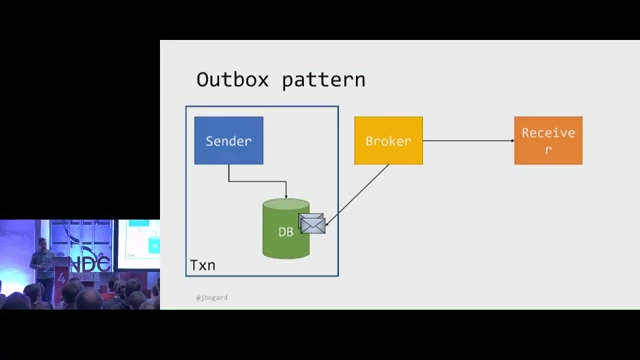
- The Outbox Pattern: To prevent the database transaction from rolling back due to queue publishing failures, messages are saved directly into the database as part of the primary transaction.
- Implementation:
- Instead of publishing directly to RabbitMQ, the application saves the message to an
Outboxtable. - A separate, asynchronous background processor polls the
Outboxtable, publishes the unsent messages, and marks them as sent. - This decouples the checkout transaction from RabbitMQ uptime.
- Instead of publishing directly to RabbitMQ, the application saves the message to an
Refactoring to a Resilient Architecture [31:10]
- Decoupled Workflow with a Process Manager (Saga): The final refactoring shifts the checkout from a tightly coupled sequential process to a distributed workflow orchestrated by a Process Manager (Saga).
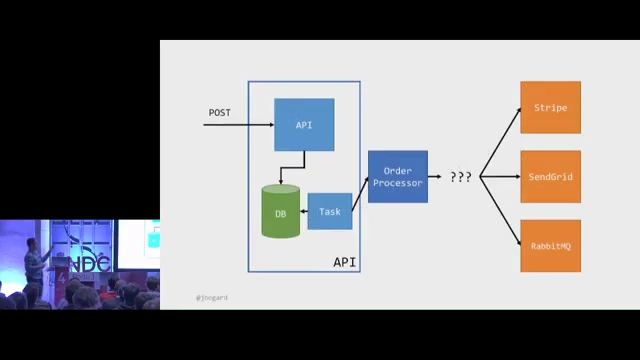
- How it Works:
- The immediate checkout action only creates a pending order in the database and dispatches a command via the Outbox.
- An asynchronous "Process Order" Saga manages the subsequent lifecycle steps (authorizing payment, capturing payment, sending emails).
- Payments are processed in a two-step "Authorize and Capture" flow, allowing safe retries and compensations without leaving the database in an inconsistent state.